

Copacetic meaning: copacetic is an adjective that means “fine,” “very satisfactory,” or “in good order.” You say it like koh-puh-SET-ik, and it’s casual American slang.
Maybe you heard “everything’s copacetic” in a movie or an old song. This guide covers the copacetic definition, its mystery origin, and easy ways to use it.
Table of Contents
What Does Copacetic Meaning?
Copacetic is a cheerful way to say “all is well.” It has four syllables and works as an adjective.
Dictionaries define it as fine, OK, or completely satisfactory. Some UK dictionaries stretch it to “very good” or “excellent.”
The word often calms a worry. If someone fears a plan went wrong, you say, “Relax, everything is copacetic.”
You can use it for:
- A mood (“The meeting felt copacetic.”)
- A relationship (“Things are copacetic between us.”)
- A project (“The launch is copacetic.”)
It’s more common in US English than in British English. It rarely appears in formal or academic writing.
While copacetic describes things that are fine, satisfactory, or in good order, English also has words that express the opposite extreme, such as ruin or damnation. Understanding the meaning of perdition helps you explore this darker vocabulary and discover how the word is used in literature, religion, and everyday expressions.
Copacetic Origin and Spelling

The copacetic origin is still a puzzle. Experts agree on the early records, but not on where the word came from.
Here’s what the record shows:
- 1919: The word first appears in print as copasetic, in Irving Bacheller’s novel A Man for the Ages.
- 1920: It shows up in the song “At the New Jump Steady Ball” by Tom Delaney and Sidney Easton.
- 1921: Singer Ethel Waters recorded that song.
- 1930s: Tap dancer Bill “Bojangles” Robinson made the word famous on the radio. He said he invented it, but no proof backs that up.
- 1953: Lexicographer Charles Earle Funke wrote about Robinson’s claim in the journal American Speech.
Other guesses include Louisiana French, Italian, and Chinook Jargon. None has solid proof.
On spelling, the standard form is copacetic. You’ll also see copasetic (the most common variant), copesetic, and copesettic. “Copasthetic” is just a mistake.
In US writing, stick with copacetic.
Copacetic Synonyms and Opposites
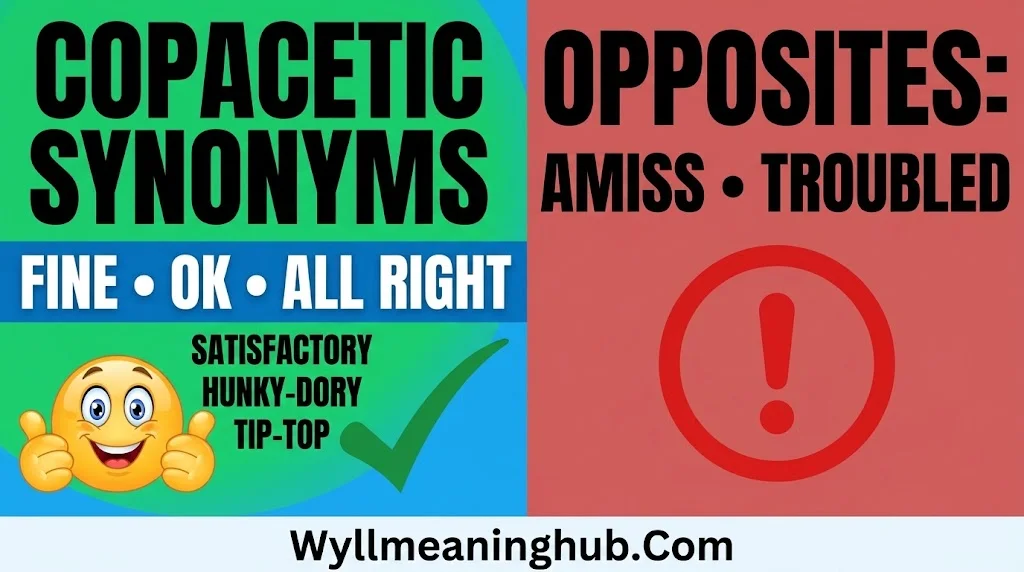
A good copacetic synonym keeps the same meaning but fits a different mood. Pick the one that matches your setting.
Common synonyms:
- Fine
- All right
- OK
- Satisfactory
- Hunky-dory (playful)
- Tip-top (upbeat)
Copacetic sounds warmer and more relaxed than “satisfactory.” It feels lighter than “excellent.”
For opposites, say something is not copacetic. You can also use troubled, amiss, or unsatisfactory.
Understanding the word “copacetic” can help you communicate smoothly in everyday conversations, but online chats often use a different kind of vocabulary. If you want to keep up with gaming conversations and digital slang, learning what AFK means in online communication will help you understand when someone is temporarily away from their keyboard.
How to Use Copacetic in a Sentence
Using copacetic in a sentence is easy. Keep it casual, and it will sound natural.
Easy examples:
- “Don’t worry about the exam. Things will be copacetic.”
- “We talked it out, and now we’re copacetic.”
- “The tour was stressful, but the show itself was copacetic.”
- “Things weren’t entirely copacetic between the two partners.”
Quick tips:
- Use it with friends, coworkers, or in texts.
- Skip it in résumés, legal papers, and essays.
- Use it once in a while. Too much feels forced.
Copacetic is also a fun alternative to “fine” when you want a little flavor.
FAQs
Why is copacetic slang?
It began in everyday speech, not in books. The first records come from fiction and song lyrics in 1919–1921. Dictionaries label it slang, and it mostly lives in casual talk.
What is a synonym for copacetic?
The closest ones are fine, all right, OK, and satisfactory. For a lighter tone, try hunky-dory or tip-top.
Can I say I am copacetic?
Yes, people will understand you. It’s informal, though, and it more often describes a situation than a person. “Things are copacetic” or “we’re copacetic” sounds more natural.
Is copacetic Yiddish?
No. A popular theory linked it to the Hebrew phrase hakol beseder (“all is in order”). Linguist David Gold rejected that idea in his 2009 book Studies in Etymology and Etiology. He found no Hebrew, Yiddish, or other Jewish source for the word.
What is a copacetic person?
There’s no standard meaning. The word usually describes things, moods, and relationships. If someone calls a person “copacetic,” they most likely mean easygoing and pleasant to be around.
The meaning of copacetic is simple: everything is fine and in good order. Its past is a mystery, but its use is easy. Say it in relaxed, friendly moments, and use the standard spelling in writing.

Aric ARHAM is a passionate writer and content creator dedicated to helping readers find the right words for meaningful moments in life. With a warm and thoughtful writing style, Aric creates heartfelt messages, wishes, greetings, and inspirational content that people can easily share with their loved ones.