
The perdition meaning is simple. It stands for eternal damnation, hell, or a state of total ruin.
Most people meet the word in church, in old books, or in dramatic news headlines. This guide covers the definition of perdition, where it came from, and how to use it today.
Table of Contents
What Is the Perdition Meaning? Definition and Pronunciation
Perdition is a noun. It names the state of being lost forever after death, as punishment for sin. It is a noncount noun, so you never say “perditions” in everyday English.
The word has a few senses, listed here from most to least common:
- Eternal damnation: the soul’s final ruin, as dictionaries define it.
- Hell: the place where the wicked suffer.
- Utter destruction: an archaic sense, now rare.
- Loss: an obsolete sense.
You say it per-DISH-un. In the US, the word sounds formal and a bit old-fashioned. It also works as a figurative word. People use it for any slow slide toward disaster, such as a “road to perdition.”
Synonyms for perdition include hell, inferno, damnation, hellfire, doom, and ruin. Other related terms are Gehenna and Tartarus, two names for places where the wicked are punished.
While perdition describes eternal damnation or a path toward ruin, English also has words that express a sharp response during a debate or conversation. Understanding the meaning of touché can help you recognize how this clever French expression is used to acknowledge a valid point or a witty comeback.
Perdition Origin and Word History
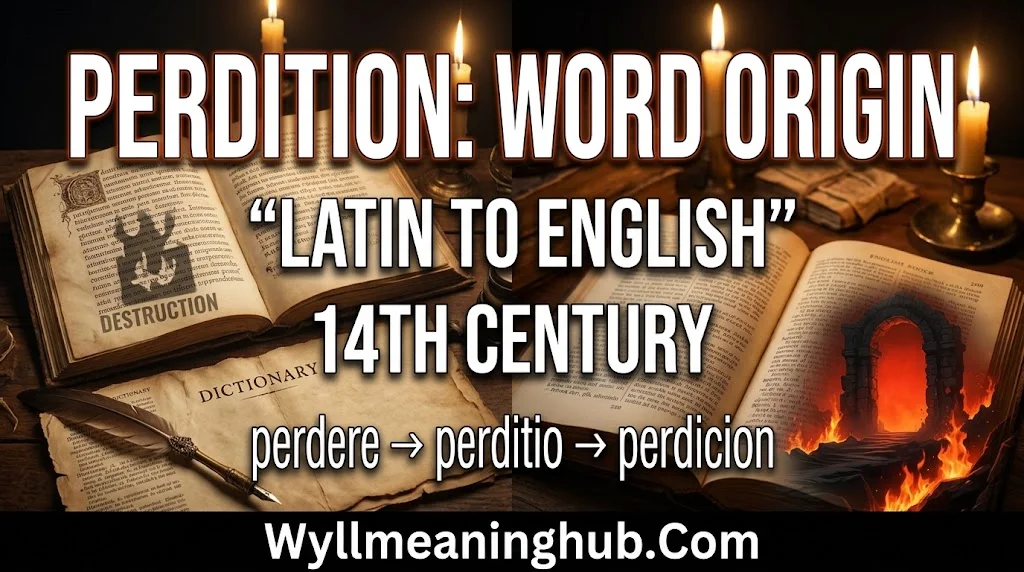
The origin of perdition goes back to Latin. The word came into English in the 14th century, and the first recorded use falls between 1300 and 1350.
Here is the path it took:
- Latin perdere: “to destroy,” built from per- (“through”) and dare (“to give”).
- Late Latin perditio: “destruction.”
- Anglo-French perdiciun: the form that crossed the Channel.
- Middle English perdicion: the early English spelling.
At first, the word meant plain destruction. Shakespeare used that sense in Othello when he wrote of “the perdition of the Turkish fleet.” Over time, the religious sense took over. Today the word is used almost only for damnation or the place where the soul is lost.
The word perish shares the same root. Both point to something lost or destroyed for good.
Perdition in the Bible, Religion and Literature
Perdition carries real weight in faith and storytelling. Religious texts and classic writers shaped how we hear the word today.
What does perdition mean in the Bible? The English Bible uses the word eight times, from John 17:12 to Revelation 17:18. It translates the Greek apoleia, which means “ruin” or “loss.” In each case, it describes the final state that is the opposite of salvation.
The best-known phrase is “Son of Perdition.” The Bible gives this title to Judas (John 17:12) and to the Antichrist (2 Thessalonians 2:3).
In books, writers lean on the word for a dark, grand tone. Milton’s Paradise Lost speaks of “bottomless perdition.” Mary Shelley’s Frankenstein and Dante’s Inferno share the same themes of ruin and punishment.
Is purgatory the same as perdition? No. Here is how the terms differ:
| Term | Meaning | Lasts |
| Perdition | Final spiritual ruin | Forever |
| Hell | The place of punishment | Forever |
| Damnation | The act or state of being condemned | Forever |
| Purgatory | A place of cleansing before heaven (Catholic belief) | Temporary |
Perdition Examples in a Sentence
Examples make any perdition definition easier to grasp. Here are original ones, grouped by use.
Religious use:
- The preacher warned that greed leads straight to eternal perdition.
- In the story, the villain is condemned to perdition.
Figurative, everyday use:
- Three deadlines in one day felt like perdition.
- Bad habits can start a slow slide toward perdition.
Literary and news style:
- The hero’s choices pave his road to perdition.
- Critics said the failed plan was a path to perdition for the company.
- Rumors of the fires of perdition filled the old village tales.
Common phrases to know:
- Road (or path) to perdition
- Fires of perdition
- Eternal perdition
- Damned to perdition
A few quick tips help. Keep the word for serious or dramatic moments. Do not mix it up with “prediction” or “partition.” And use it lightly in casual talk, since it can sound humorous or over the top.
FAQs
What is the literal meaning of perdition?
Literally, perdition means “utter destruction” or “loss.” It comes from the Latin perdere, “to destroy.” In daily use, it means eternal damnation, or a state of final spiritual ruin with no way back.
What is the synonym of perdition?
The closest synonyms are hell, damnation, and inferno. You can also use doom, ruin, or hellfire, depending on the sentence. For the destruction sense, try downfall or devastation.
Is purgatory the same as perdition?
No. Purgatory is a temporary state of cleansing in Catholic belief. Perdition is final and cannot be undone. A soul in purgatory is headed to heaven. A soul in perdition is lost for good.
How do you use perdition in a sentence?
Use it for ruin or damnation. A literal example: “The monk feared perdition for his sins.” A figurative one: “Late fees sent his finances down the road to perdition.”
What type of word is perdition?
Perdition is a noun. It is noncount and formal, and some dictionaries call it old-fashioned. It is usually a mass noun, so it takes no “a” or “an.”
The meaning of perdition is easy to remember: it is the word for final ruin. It began as “destruction” in Latin and became “hell” in faith and literature. Today it can also describe any dramatic downfall. Use it with care, and it adds real force to your writing.

Aric ARHAM is a passionate writer and content creator dedicated to helping readers find the right words for meaningful moments in life. With a warm and thoughtful writing style, Aric creates heartfelt messages, wishes, greetings, and inspirational content that people can easily share with their loved ones.