
Touché is a short word with a sharp bite. You say it when someone makes a smart point and you have no comeback.
This guide covers the touché meaning, its French roots, how to say it, and how to use touché in a sentence. You will also learn when to skip it.
Table of Contents
What Does Touché Mean? Definition & Origin
Touché is an interjection, a short word you say on its own. It has two main jobs.
- In fencing: it admits that your opponent landed a hit.
- In conversation: it admits that someone made a clever or fair point.
The Britannica Dictionary defines it as a word used to admit that someone made an effective point in an argument.
The origin of touché is French. It is the past participle of the verb toucher, “to touch,” so it literally means “touched.” Dictionaries date its first use in English to somewhere between the late 1890s and the early 1920s.
The meaning moved from a physical hit to a verbal one. Linguists call this a semantic shift. In both cases, you got hit and you can’t deny it.
That is why the word feels so witty. It lets you lose with style, which makes it a graceful concession.
Understanding touché reveals how language can turn a clever response into a graceful concession. If you enjoy exploring words with interesting cultural roots, discover the Japanese meaning of anjin, a term associated with a ship’s pilot or navigator and its historical significance in Japanese culture.
Touché Meaning in English vs. French (Pronunciation & Spelling)
The word looks the same in both languages, but people use it differently. Pronunciation and spelling trip up many English speakers.
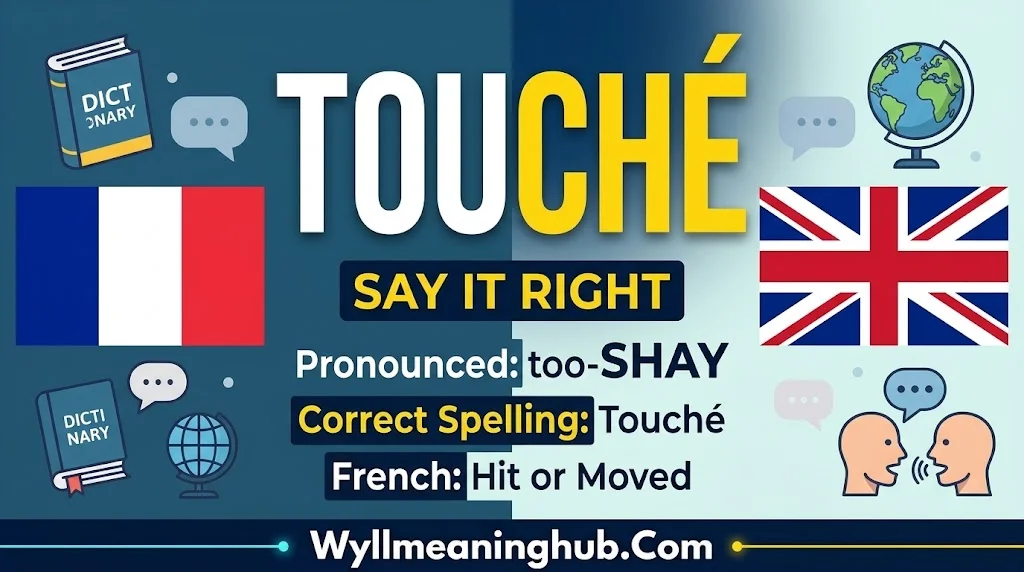
How do you pronounce touché? Say too-SHAY. It has two syllables, with stress on the second. The accent mark signals this, so it is not “toosh,” according to Grammarist. A common misspelling is “tushay.”
How do you type the accent?
- Mac: Option + E, then E.
- Windows: hold Alt and type 0233 on the number pad.
- iPhone and Android: press and hold the “e” key.
Dictionaries list touché with the accent as the correct spelling. Plain “touche” is common in texts and posts.
In French, people rarely use touché alone to mean “good point.” They say bien vu or très juste instead. French touché usually means “hit,” “moved,” or “affected.” Ton film m’a touchée means “Your film moved me.”
French speakers also play Touché Coulé, their version of the board game Battleship. The name of the accounting firm Deloitte & Touche is different too. Touche there is a surname, not the interjection.
How to Use Touché in a Sentence (And When to Say It)
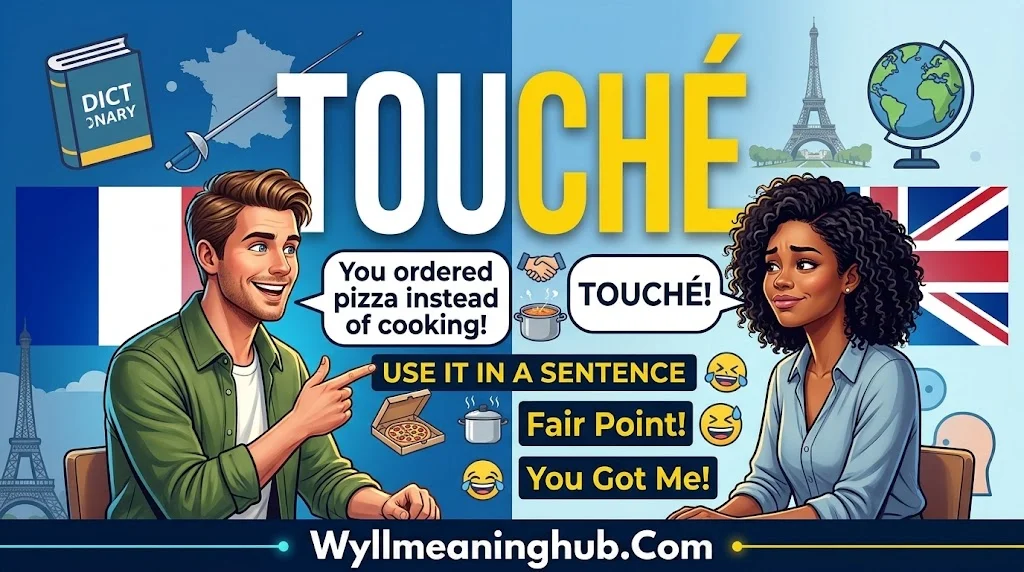
Use touché right after someone scores a point against you. Keep it short and let the other person enjoy the win.
Here are a few touché examples:
- “You said you’d cook tonight. You ordered pizza.” “Touché.”
- “We missed the deadline because we changed the plan twice.” “Touché. I’ll own that.”
- “Touché. I can’t argue with that.”
- A text reply: “Touché 😂”
When can you say touché?
- When the other person made a fair, clever point.
- When a comeback made you laugh.
- When you lose a friendly debate.
- During a fencing bout.
When should you skip it? Skip it in serious arguments, sensitive talks, and formal writing. Also skip it if you disagree. Saying it without meaning it sounds fake.
If someone says touché to you, a simple “Thanks” or “I’ll take the win” works well.
Touché Slang, Tone & Common Mistakes
In everyday speech, touché slang means “you got me” or “fair point.” It is casual and playful. Tone changes everything. Said warmly, it shows respect. Said with an eye roll, it sounds like a jab.
You can swap in other phrases for variety:
- Fair enough
- Good point
- You got me
- Point taken
- Well played
Avoid these common mistakes:
- Overusing it in one chat.
- Spelling it “tushay.”
- Saying “toosh” instead of “too-SHAY.”
- Using it when you actually disagree.
FAQs
What does touché mean in slang?
In slang, touché means “good one” or “you got me.” It admits that someone made a smart or witty point.
Is touché a compliment?
Not exactly. It is an acknowledgment. It does show respect for the other person’s point, so it often feels like a small compliment.
Why does someone say “touche”?
People say it to concede a point with humor. It comes from fencing, where it admits a hit. In talk, it admits a verbal “hit.”
How do I use touche in a sentence?
Say it right after a good point. For example: “You’re right, I did forget. Touché.”
When can I say “touche”?
Say it when someone makes a fair or clever point, or wins a playful debate. Skip it in serious or formal moments.
Now you know the touché meaning, the pronunciation, and how to use it. Say too-SHAY and keep it short. Use it when a point lands, and you will sound sharp and gracious at once.

Aric ARHAM is a passionate writer and content creator dedicated to helping readers find the right words for meaningful moments in life. With a warm and thoughtful writing style, Aric creates heartfelt messages, wishes, greetings, and inspirational content that people can easily share with their loved ones.