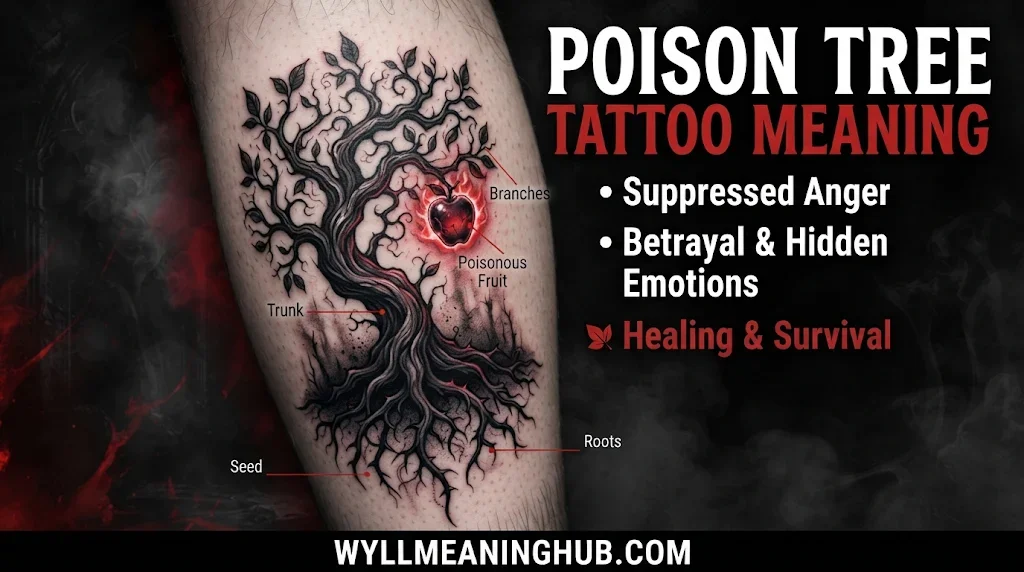
A poison tree tattoo looks like a plain tree at first. Then you notice the twisted branches, the deep roots and the one dark fruit. That is when people ask, “Wait, what does that mean?”
This guide gives you the full poison tree tattoo meaning. You will learn where the symbol comes from, what each part stands for and how to plan a design you will still love years from now.
Table of Contents
What Does a Poison Tree Tattoo Mean?
The meaning is simple to state and rich to explore. Start with the short answer, then look at why it works.
A poison tree tattoo most often symbolizes suppressed anger, resentment, betrayal and the consequences of hiding your feelings. It can also stand for healing, because many wearers use it to mark a hard chapter they survived.
A tree normally means life, family and growth. Poison means harm. Together they say one thing: something harmful grew over time. That is why the tattoo fits hidden emotions so well.
The parts of a tree also match the way a feeling grows:
- Seed: a small hurt or insult
- Roots: feelings you keep out of sight
- Trunk: the feeling getting stronger with time
- Branches: the feeling spreading into other parts of life
- Fruit: the result, or the consequences
Think of watering a weed. Each day of attention makes it taller. The tattoo turns that idea into a picture.
What does a poison tree tattoo mean to different people? Meaning depends on the wearer. Here are the most common readings:
| Reason for the tattoo | What the tree says |
| Literary tribute | “I love Blake’s poem.” |
| Suppressed anger | “I know what silence can grow into.” |
| Betrayal | “That experience changed me.” |
| Toxic relationship | “I got out.” |
| Healing | “Something new grew after the pain.” |
| Style only | “I like dark botanical art.” |
Why do Americans get meaningful tattoos at all? A Pew Research Center survey found that 32% of U.S. adults have a tattoo. About 22% have more than one. Around 69% said they got a tattoo to honor or remember someone or something. About 47% said they wanted to make a statement about what they believe.
So a poison tree tattoo fits a common pattern. People use ink to hold a story, not just a picture.
A poison tree tattoo can symbolize hidden emotions, personal struggles, and the lessons people carry from difficult experiences. Similarly, understanding modern slang and abbreviations can reveal how language expresses identity and personal meaning, which is why exploring the meaning of LGF in texting and online conversations offers another interesting look at how people communicate.
Does a poison tree tattoo always mean something bad? No. The look is dark, but the message is often hopeful. A person can wear it as a warning, a lesson or a sign of survival.
History of the Poison Tree: From Blake’s Poem to Modern Ink
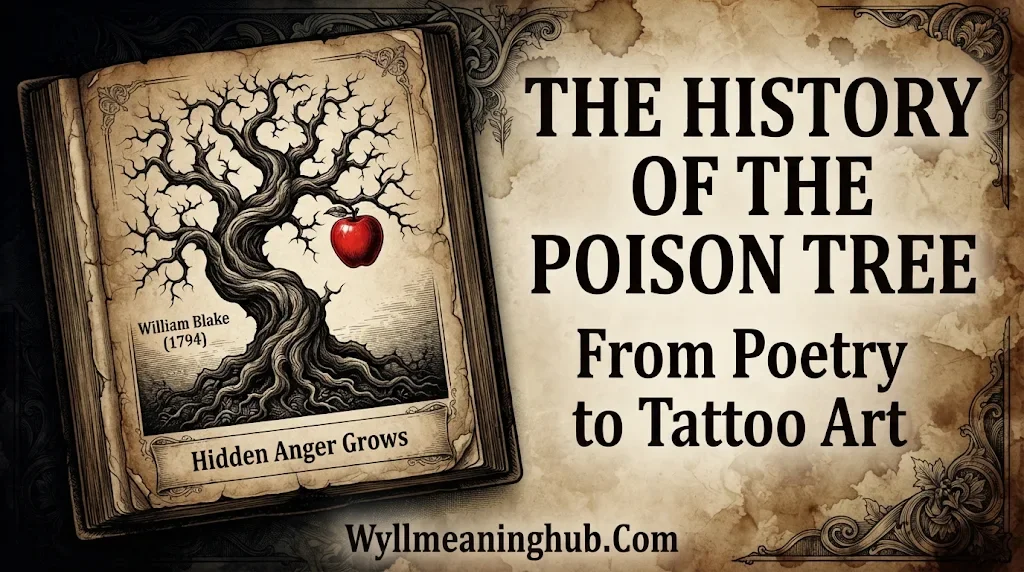
This symbol has deep roots. Where does the poison tree come from? It comes from “A Poison Tree,” a short poem by English poet William Blake.
William Blake (1757–1827) was a poet, painter and engraver. He published the poem in Songs of Experience in 1794. That book is the darker partner of his earlier Songs of Innocence. You can read the poem free at the Poetry Foundation.
What happens in “A Poison Tree”? The story is short and sharp:
- The speaker gets angry with a friend.
- He says so, and the anger ends.
- He gets angry with a foe.
- He says nothing, and the anger grows.
- He feeds it with fear and fake smiles.
- It becomes a tree that bears a bright apple.
- The foe sneaks in, eats the apple and is found dead under the tree.
The lesson is clear. Anger you speak tends to fade. Anger you hide tends to grow. That one idea sits behind almost every poison tree tattoo.
A few facts add depth:
- Blake made his poems as illustrated plates. He worked with words and images together, so the poem moves easily into tattoo art.
- Records at the Blake Archive show how Blake worked and revised his poems. An early notebook draft of this poem carried a different title.
- Many readers link the apple to the Forbidden Fruit in Genesis, as BBC Bitesize notes. Still, the poem is not a retelling of that story. Blake builds his own metaphor.
Is the poem a warning or an invitation? Readers split on this. Some see a warning about hatred and revenge. A poet writing for Finding Blake reads it as advice to face real anger and speak it. Others see an invitation to let buried pain go. Goth culture leans toward the dark side of the poem. Therapy culture leans toward release and recovery.
That open ending helps explain the tattoo’s appeal. One poem gives you many stories.
Why did the poem become a tattoo? Literary tattoos let people carry an idea without spelling it out. A tree with dark fruit also reads well from a distance. You do not need to know Blake to feel the mood.
The popularity of tattoos has also grown. Pew reported that 23% of adults had a tattoo in 2010. The 2023 figure was 32%. Pew warns that survey changes make the two numbers hard to compare directly. Even so, most Americans say society has grown more accepting of tattoos.
Poison Tree Tattoo Symbolism: Roots, Fruit, Colors & Myths
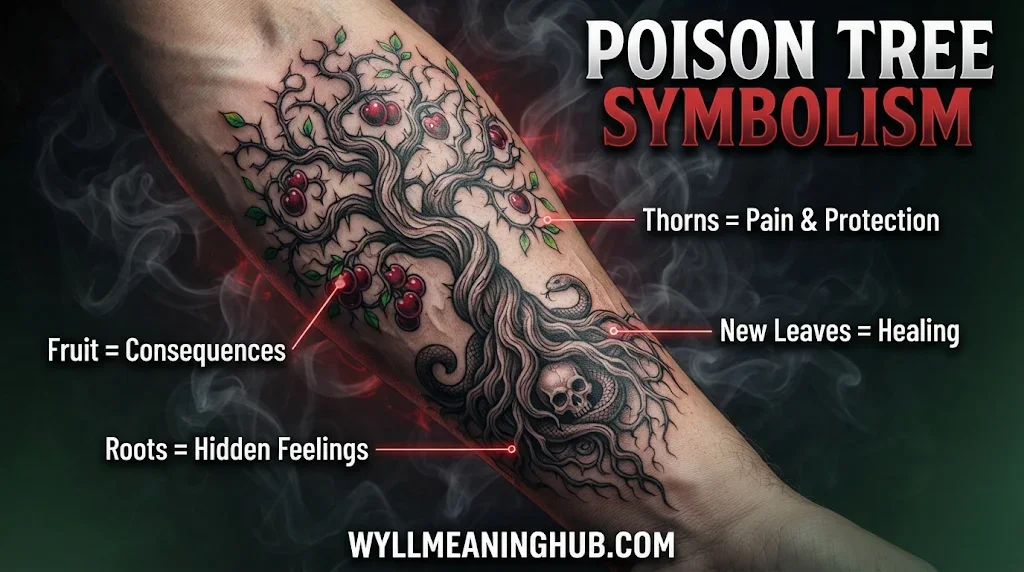
Every part of the design can carry a meaning. Think of the parts as words in a sentence.
| Element | Common meaning |
| Roots | Buried feelings, old history |
| Exposed roots | Hidden pain coming to light |
| Trunk | Time, endurance, scars |
| Twisted branches | Inner conflict |
| Broken branches | Lost trust, ended bonds |
| Poisonous fruit | Consequences, temptation |
| Apple | A direct link to Blake |
| Thorns | Pain, defense, boundaries |
| Snake | Deceit, temptation, danger |
| Skull or crows | Mortality, a gothic mood |
| New leaves or flowers | Recovery, renewal |
| Falling fruit | Letting go, the end of a cycle |
These are not fixed rules. Tattoo symbolism works like a language, not a dictionary. Thorns can mean pain for one person and protection for another.
What do the colors in a poison tree tattoo mean?
- Black and gray feel serious, moody and gothic. They also show bark and roots well.
- Red fruit can suggest anger, danger or passion. A single red apple on a gray tree grabs the eye.
- Green leaves add life and hope.
- Deep blue or purple give a dreamy, fantasy feel.
Color has no single meaning. The same red apple could mean rage to one person and love to another.
What is the psychological meaning of a poison tree tattoo? The tree is a picture of unresolved anger and rumination. Psychologists use rumination for replaying a hurt again and again. A tree grows slowly, and so do these habits. The tattoo can remind you to speak up, set boundaries or let a grudge go. It does not need to diagnose anything. It is a symbol.
What are the biggest myths about this tattoo?
- “It always means revenge.” Not true. Revenge is part of the poem, but wearers often mean regret, warning or healing.
- “It always comes from Blake.” Not true. Some people love dark botanical art and nothing more.
- “Dark art must have a dark meaning.” Not true. A black tree with fresh leaves can mean survival.
- “The apple always means the same thing.” Not true. Even this symbol shifts with context.
How is a poison tree different from other tree tattoos?
| Feature | Poison tree | Tree of life |
| Main theme | Harmful growth, consequences | Life, family, strength |
| Look | Twisted, dark, damaged | Full, balanced, healthy |
| Fruit | Danger or temptation | Abundance |
| Roots | Hidden emotions | Heritage, grounding |
| Mood | Reflective, dark | Peaceful, hopeful |
The Tree of Knowledge of Good and Evil from Genesis is a different symbol again. A poison tree tattoo may borrow its fruit, but it is not a religious emblem. Its meaning comes from the wearer and the design.
Poison Tree Tattoo Design Ideas, Placement & Tattoos to Avoid
Start with the message. Then pick the look that fits it.
What are the best poison tree tattoo design ideas?
- Blackwork: bold lines and strong contrast. It suits a gothic mood.
- Fine line: thin, delicate lines. It works for small spots.
- Watercolor: soft color behind the branches for a dreamy feel.
- Realistic: detailed bark and a lifelike apple.
- Blake-inspired: a gnarled tree, one apple and maybe a short line from the poem.
- Half dead, half alive: pain on one side, healing on the other.
- Dead tree with new growth: the clearest sign of recovery.
- Minimalist: a simple silhouette with one fruit.
How do you match the design to your story? Use this simple formula:
Past experience + feeling + symbol = your tattoo story
For example:
- Betrayal + healing + broken tree with new leaves = survival and growth
- Hidden anger + self-awareness + one poisonous apple = a reminder not to feed resentment
Keep the symbols few. Too many details make the picture hard to read. If you add a snake, decide what it means first.
Where should you place a poison tree tattoo?
| Placement | Best for |
| Forearm | Tall designs you can show or cover |
| Upper arm | Medium detail, roots and fruit |
| Back or shoulder blade | Large trees with wide branches |
| Chest | Personal, detailed pieces |
| Ribs | Private designs (bony spots often hurt more) |
| Thigh or calf | Tall, detailed or realistic work |
| Wrist or ankle | Small, simple designs |
Placement is about size, visibility and detail, not fixed meaning.
Will a poison tree tattoo age well? Trees have many thin lines. Tiny roots and branches can blur as skin ages. Bold shapes and clear outlines usually last better than crowded detail. Ask your artist how the design will look in ten years.
How do you choose the right tattoo artist? Look at portfolios. Pick someone with strong work in trees, plants, blackwork or illustration. Bring your story, not just a picture. A good artist can turn it into clear shapes.
What should you ask before getting a poison tree tattoo?
- What does the tree mean to me?
- Do I want a dark or a hopeful message?
- Should the Blake link be obvious or subtle?
- Will I still connect with this in five years?
- Is the design simple enough for the size I chose?
How do you care for the tattoo? Follow your artist’s aftercare steps. In general, keep the area clean, avoid picking at scabs and protect it from direct sun while it heals. Skin can look healed on top before it is healed underneath.
What are tattoos to avoid? Skip these:
- Impulse designs you haven’t thought about for a few weeks
- Tiny pieces packed with detail
- Copies of another artist’s custom work
- Symbols you haven’t researched
- Partner names, which carry extra risk if the relationship ends
The risk of regret is real. Pew found that about 24% of tattooed Americans regret at least one of their tattoos. Time and research are cheap protection.
FAQs
What does A Poison Tree symbolize?
It symbolizes anger that is hidden and fed until it turns deadly. In the poem, spoken anger fades and silent anger grows into a tree with poisonous fruit.
What is the meaning of the poison tree?
It is Blake’s picture of resentment. The seed is a small hurt. The fruit is the harm that follows. In tattoos, it can also stand for betrayal, toxicity, warning or healing.
Why did Mike Tyson get a Che Guevara tattoo?
This question is not about the poison tree, but it shows how personal tattoo meaning can be. Tyson has said he chose his Mao and Che tattoos in prison, when he was angry at society and had no faith in the government, as AOL reports. The Che design copies Alberto Korda’s famous photo, according to Wikipedia. The point is that the same kind of image can mean something different to each person.
What are tattoos to avoid?
Avoid rushed designs, tiny over-detailed art, copied custom work, unresearched symbols and partner names. Wait a few weeks before you commit to any idea. About 24% of tattooed Americans report regret, per Pew.
What does poison tree tattoo mean?
A poison tree tattoo usually means suppressed anger, resentment and betrayal. It can also mean healing, self-awareness and survival. The wearer’s story decides which one.
A dark tree does not have to point to a dark future. Often it marks the hardest chapter you already beat.
Pick a design where every detail has a reason. Tell your artist the story behind it. Then let the tree say what words can’t.

Aric ARHAM is a passionate writer and content creator dedicated to helping readers find the right words for meaningful moments in life. With a warm and thoughtful writing style, Aric creates heartfelt messages, wishes, greetings, and inspirational content that people can easily share with their loved ones.