

Carino meaning in Spanish (spelled cariño) is warm, gentle affection. People also use it as a term of endearment, like “honey” or “dear.”
English has no single word for it. It sits between “like” and “love.” This guide shows what it means, how to say and type it, and when it fits, so you can use it with confidence.
Table of Contents
What Does Cariño Mean in English? (Carino Meaning Explained)
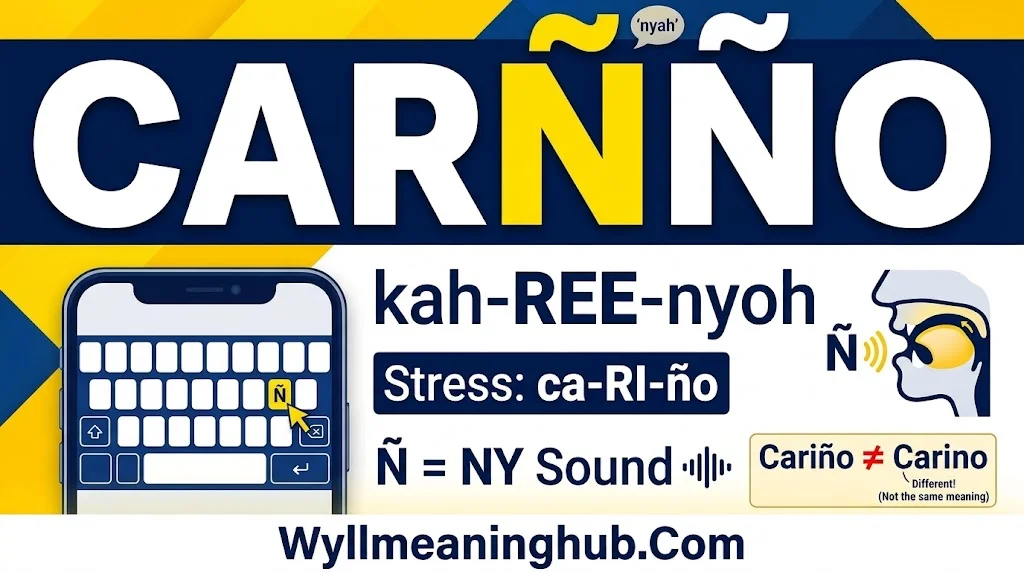
The meaning of cariño starts with one idea: kind, close feeling toward someone or something. Let’s look at what the dictionary says, then at sound, spelling, and word family.
What does cariño mean in English? It means affection, fondness, or tenderness. The Royal Spanish Academy lists three senses for the word:
- A feeling of attachment. You want the person, pet, or thing near you. People can even feel cariño for an old couch.
- A word for the person you feel it for. This is the pet-name use, like “honey.”
- Care in how you do something. Handle fine glasses with cariño, and you handle them gently.
The dictionary adds one more detail. The plural, cariños, often means kind words or gestures, like the way a child pets a baby.
Understanding cariño helps you express affection and warmth in Spanish, but everyday conversations often include other useful abbreviations and expressions. If you’re curious about common texting shorthand, explore the meaning of ETA in texting, what it stands for, and how people use it in everyday digital conversations.
| Sense of cariño | Closest English word | Example |
| Feeling | affection, fondness | Le tengo mucho cariño. (I’m very fond of her.) |
| Pet name | honey, dear, sweetheart | Gracias, cariño. (Thanks, honey.) |
| Care in action | tenderness, love, care | Lo hizo con cariño. (He did it with care.) |
| Gestures | caresses, kind words | Le hizo cariños al perro. (She petted the dog.) |
Why is it so hard to translate? Picture a love scale. “Like” sits low. Passionate love sits high. Cariño lives in the warm middle. Because English has no word for that spot, every translation fits only part of it.
The word matters because Spanish is huge. The Instituto Cervantes’ 2025 yearbook counts about 635.7 million Spanish speakers worldwide. About 520 million of them speak it natively. That makes Spanish the third most spoken native language on Earth, behind Mandarin Chinese and Hindi.
How do you pronounce cariño? Say kah-REE-nyoh. The stress falls on the middle syllable: ca-RI-ño. The r is one quick tap of the tongue. The ñ sounds like “ny” in “canyon.”
How do you type ñ?
- iPhone and Android: hold the N key, then slide to ñ.
- Mac: press Option + N, release, then press N.
- Windows: hold Alt and type 0241 on the number pad. For a capital Ñ, type 0209.
- Any device: copy and paste ñ if nothing else works.
Is it carino or cariño? The ñ matters. In Spanish, ñ is its own letter, not a decoration. Drop it, and you may end up with a different word, or no word at all.
The spelling carino is a real word, but in Italian. It comes from caro (“dear”) plus a small-size ending. It is an adjective that means “cute,” “pretty,” or “nice,” and it changes form: carino, carina, carini, carine. Same letters, different language, different job. Portuguese has its own cousin, carinho, which also means affection.
Related words show how big the family is:
- Cariñoso/a: affectionate, as in a warm person or a kind hug.
- Cariñosamente: affectionately.
- Cariñito: a smaller, sweeter form.
- Cariños: the plural, for kind words and gestures.
- Encariñarse: to grow fond of someone. The dictionary defines the root verb as making someone fond of something.
- Tener cariño: to feel affection for someone.
- Sin cariño: without affection or care.
The family is old, too. The Academy’s historical dictionary lists acariñar, an older verb that means to treat with affection or to caress.
How to Use Cariño in Spanish: Meaning, Examples and “Con Cariño”
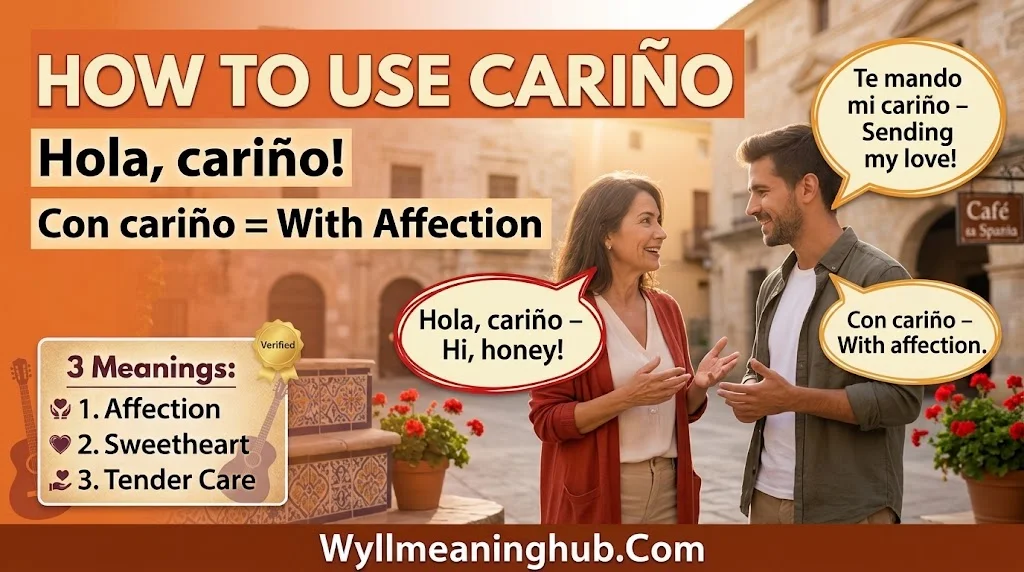
Cariño works as a name, a feeling, and a way of acting. You will meet all three in daily life. About 42 million people in the US spoke Spanish at home in 2022, per Census Bureau data, so the word is never far away.
How do you use cariño in a sentence? Here are the main patterns.
- As a pet name: “Hola, cariño.” (Hi, honey.) “¿Cómo estás, cariño?” (How are you, dear?)
- To show fondness: “Le tengo mucho cariño a mi maestra.” (I’m very fond of my teacher.)
- For care in action: “Cocinó con mucho cariño.” (She cooked with great love.)
- For sympathy: “Te mando mi cariño.” (I’m sending you my love.)
- For a warm welcome: “Los recibimos con todo cariño.” (We welcome you with all our affection.)
- For greetings to others: “Dale cariños a tu familia.” (Give my love to your family.)
What does con cariño mean? It means “with affection.” It is a soft way to end a card, a note, or a text. It is not always romantic. You can sign a thank-you to your teacher with it.
Where can you use con cariño?
- Greeting cards and gift tags
- Letters and personal emails
- Sympathy notes
- Text messages to people you know well
How strong is each sign-off? Use this quick ladder, from lighter to stronger.
| Phrase | English | Feel | Good for |
| Con cariño | With affection | Warm, kind | Friends, teachers, coworkers you know |
| Con mucho cariño | With much affection | Very warm | Family, close friends |
| Con todo mi cariño | With all my affection | Deeply warm | Grandparents, sympathy notes |
| Cariñosamente | Affectionately | Gentle, a bit formal | Cards and letters |
| Con amor | With love | Strongest | Partners, close family |
What can you write in a card or text? Copy and adapt these lines:
- Teacher: “Gracias por enseñarme tanto. Con cariño, Luis.” (Thank you for teaching me so much. With affection, Luis.)
- Friend who moves away: “Te voy a extrañar. Un abrazo con mucho cariño.” (I’ll miss you. A hug with much affection.)
- Grandparent: “Feliz cumpleaños, abuela. Te abrazo con todo mi cariño.” (Happy birthday, Grandma. I hug you with all my affection.)
- Coworker who is ill: “Te deseo una pronta recuperación. Con cariño, Marta.” (I wish you a quick recovery. With affection, Marta.)
- Sympathy card: “Estoy contigo en este momento tan difícil. Con todo mi cariño.” (I’m with you in this hard time. With all my affection.)
- Partner: “Buenos días, mi cariño. ¿Dormiste bien?” (Good morning, my darling. Did you sleep well?)
- Quick text: “Ya llegué. Un beso, cariño.” (I’m here. A kiss, honey.)
For formal or work emails, cordialmente or saludos cordiales is the safer sign-off. Save con cariño for people you know.
How do you reply when someone calls you cariño? Keep it easy. Say “Gracias, cariño” or “Igualmente.” You can also just smile. The warmth does the work.
How does cariño compare with other pet names?
| Pet name | Meaning | Feel |
| Cariño | Affection, dear | Gentle, flexible |
| Mi amor | My love | More romantic |
| Mi vida | My life | Very loving |
| Mi cielo | My heaven | Sweet, soft |
| Corazón | Heart | Warm, close |
| Tesoro | Treasure | Tender, often for kids |
| Mijo / mija | My son / my daughter | Family warmth, common in many Latino homes |
Cariño is the gentlest of the group. It also fits the most people.
How should tone change by relationship?
- Partner: sweet and natural.
- Child or grandchild: very common and tender.
- Friend: warm, if you’re close.
- Coworker: skip it unless your team is already very friendly.
- Stranger: can sound too familiar, much like “honey” in English.
In bilingual US homes, the word often slips into English sentences. You may hear “Thanks, cariño” at dinner or see it in a text. That mix of languages is common, and it keeps the word warm and familiar.
Is Cariño Romantic? Gender, Etiquette and Common Mistakes
Cariño can sound sweet, romantic, or simply kind. Context decides which. Here is how to read it, say it, and avoid the usual slips.
Is cariño romantic? It can be. But parents use it with children, grandparents use it with grandchildren, and friends use it too. Three clues tell you the meaning:
- Who says it: a partner, a parent, or a friend.
- How it sounds: soft and slow, or light and quick.
- What comes with it: adding “mi” (“mi cariño”) makes it more personal.
Is cariño flirty or just friendly? On its own, it is warm, not flirty. The same word can feel different from a stranger. Like “honey” in English, it can sound too familiar, or even patronizing, when the speaker does not know you.
Does cariño change for men and women? The noun does not. Cariño is masculine in grammar (el cariño), yet people use it for anyone. Only the adjective changes: cariñoso for a man, cariñosa for a woman.
Is cariño the same as “I love you”? No. It means “I care for you.” Spanish has other phrases for stronger feelings.
| Phrase | Rough meaning | Strength |
| Cariño | Affection, dear | Gentle |
| Te quiero | I care for you / I love you | Warm, used with family, friends, and partners |
| Te amo | I love you | Stronger, usually romantic |
| Con cariño | With affection | Soft sign-off |
| Con amor | With love | Strong sign-off |
What etiquette rules should you follow?
- Match the word to how close you are.
- Go easy with people you just met.
- Add “mucho” (“mucho cariño”) to make it warmer.
- Skip pet names at work, even on friendly teams, unless you know the person well.
- Listen first. If someone calls you cariño, you can answer in kind.
What mistakes do English speakers make most often?
- Dropping the ñ. Write cariño, not carino.
- Thinking it only means romance. It also covers family, friends, and care.
- Using it as a hello for everyone. It works best with people you know.
- Mixing it up with Italian carino. That word means “cute” or “nice,” and it is an adjective.
- Treating it as “I love you.” It says “I care,” which is softer.
Quick do’s and don’ts:
- Do use it with people you’re close to.
- Do keep the ñ and the soft, rolling “ny” sound.
- Do pair it with a kind tone.
- Don’t use it to flirt with strangers.
- Don’t use it with a new boss or client.
- Don’t assume it means romance. Check the tone first.
FAQs
These short answers cover the questions people ask most about the carino meaning.
Can I call my boyfriend Cariño?
Yes. It is a sweet pet name, and it works for any gender. Many couples use it every day. Say it softly, keep the ñ, and add “mi” (“mi cariño”) to make it more personal. For a more romantic feel, try “mi amor.”
Is Carino flirty?
Not on its own. The word means affection, and families use it all the time. The tone and the speaker decide how it lands. From a stranger or a new coworker, it can feel too familiar. In Italian, sei carino (“you’re cute”) can sound lightly flirty, so the spelling and the language matter.
Can you say carino to a girl?
Yes. Cariño has no gender limit, so you can say it to a girl, a woman, a boy, or a man. It fits a friend, a daughter, a partner, or a grandmother. Use it when you know the person, and keep your tone kind. In Italian, the form for a girl is carina.
Does cariño mean darling?
Often, yes. The dictionary says people use cariño to address the person they feel affection for. That is why “darling,” “honey,” “dear,” and “sweetheart” are common translations. The deeper meaning is affection and fondness, which is wider than one pet name.
Is cariño romantic to a girl?
It can be, but not always. Many people say it to daughters, nieces, and friends. If you want a clear romantic signal, use “mi amor” or end a note with “con amor.” Tone, closeness, and context will show which meaning you intend.
Conclusion
Cariño is a small word with a big heart. It means affection, it works as a term of endearment, and it fits family, friends, and partners.
Keep the ñ, match your tone to the person, and choose the sign-off that fits: con cariño for warm, con amor for love. Try one phrase today and see how much warmth one word can carry.

Aric ARHAM is a passionate writer and content creator dedicated to helping readers find the right words for meaningful moments in life. With a warm and thoughtful writing style, Aric creates heartfelt messages, wishes, greetings, and inspirational content that people can easily share with their loved ones.