

You studied for hours, but you still failed the test. You called customer service three times, and nobody fixed the problem. In both cases, the effort did not work.
That is where “to no avail” fits. This guide covers the to no avail meaning, where it comes from, and how to use it in a sentence without mistakes.
What Does “To No Avail” Meaning?
“To no avail” means without success. It tells the reader that an effort led nowhere.
Here is a quick example: She knocked on the door for ten minutes, but to no avail.
The phrase is an idiom, so the words work as one unit. It carries a mild, tired feeling. Think of frustration, resignation, or disappointment.
It is neutral in tone. You can use it in a news story, a school essay, or a work email. It is less common in fast, casual texting.
Here is how it compares with two close phrases:
- To no avail: Comes after the effort. “We searched all day, to no avail.”
- Of no avail: Describes a thing as useless. “His apology was of no avail.”
- In vain: Means the same thing but often sits next to the verb. “They tried in vain.”
Understanding phrases like “to no avail” helps you express unsuccessful efforts clearly, while learning popular slang makes everyday communication even easier. If you’re exploring modern expressions, discover the meaning of OOTD in fashion and social media and how people use it to share their daily outfits and personal style.
Origin of “To No Avail” and the Word “Avail”

The phrase looks old-fashioned because it is. Its key word, avail, has a long history.
In this idiom, avail means advantage, benefit, or help. That sense has been in English since the mid-1400s, according to Dictionary.com.
The word traces back to the Old French valoir, which comes from the Latin valere, meaning “to be worth” or “to be strong.” So “no avail” literally means “no worth” or “no gain.”
Today, you rarely see avail as a noun on its own. It lives in fixed phrases, such as “to little avail”, “of no avail,” and “without avail.”
Do not confuse it with available or availability. They share a root, but they carry a different meaning in daily use.
How to Use “To No Avail” in a Sentence
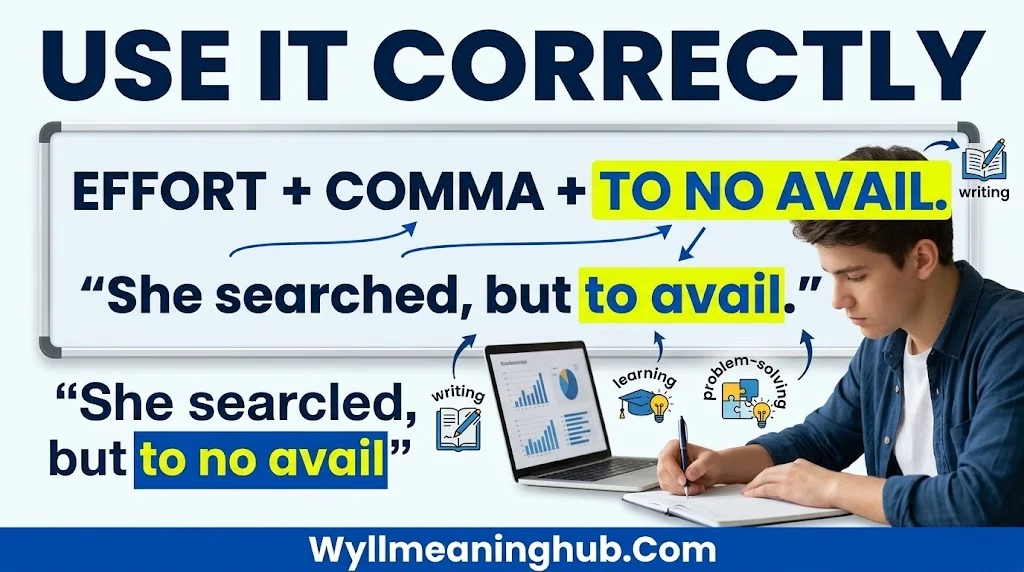
Using the phrase right is simple. Name the effort first. Then add “to no avail” to show it failed.
The usual pattern is: action + effort + comma + to no avail.
How to use “but to no avail” in a sentence? Place it after a comma at the end of a clause. Add “but” to sharpen the contrast.
- He tried to fix the sink himself, but to no avail.
- The team sent three emails, to no avail.
- She searched the store for her size, but to no avail.
You can also place it in the middle of a sentence. Set it off with commas.
- The doctors, to no avail, tried several treatments.
Here are examples for real-life settings:
- Work: I asked for a meeting with my manager, to no avail.
- School: He read the chapter twice, but to no avail. The test was still hard.
- Customer service: We called the airline for hours, to no avail.
- News: Officials urged residents to leave, but to no avail.
Use “of no avail” when the subject is the thing that failed. For example: Her pleas were of no avail.
“To No Avail” Synonyms and Common Mistakes
Many synonyms share the same meaning. Pick the one that matches your tone.
What is another word for “no avail”? Common choices include fruitless, in vain, ineffective, unsuccessful, useless, and unproductive.
Match the word to the setting:
- Formal: fruitlessly, ineffectually, to no purpose
- Neutral: without success, in vain
- Casual: for nothing, no luck
The opposite idea is successfully, to good effect, or with great success.
Avoid these common mistakes:
- Adding an “s.” Say “to no avail,” not “to no avails.”
- Using it for a good result. The phrase always signals failure.
- Starting a sentence with it. It sounds odd in most cases. Place it after the effort.
- Mixing it up with “available.” The two words are not interchangeable.
- Overusing it. One or two uses per piece is plenty.
FAQs
Is it correct to say “to no avail”?
Yes. It is standard English and appears in major dictionaries. Use the exact form “to no avail.” Do not add an “s” to “avail.” It works in both formal and everyday writing.
How to use “but to no avail” in a sentence?
Put it after a comma at the end of a clause. Say what someone tried first. For example: They waited for hours, but to no avail. The word “but” adds a clear contrast.
What is another word for “no avail”?
Good options are “in vain,” “fruitless,” “ineffective,” and “unsuccessful.” For a casual tone, try “for nothing.” For a formal tone, try “to no purpose.” Choose the one that fits your sentence.
How do you use “avail” in a sentence?
As a noun, it appears in set phrases: The warning was of little avail. As a verb, it means “to help” or “to use”: Guests can avail themselves of the free shuttle.
What does “to no avail” mean?
It means without success. The effort was made, but it did not work or help. For example: We tried to reach him by phone, but to no avail.
Now you know the “to no avail” meaning, its history, and the right way to use it. Remember the simple pattern: show the effort, add a comma, then close with the phrase. Try writing one sentence of your own today.

Aric ARHAM is a passionate writer and content creator dedicated to helping readers find the right words for meaningful moments in life. With a warm and thoughtful writing style, Aric creates heartfelt messages, wishes, greetings, and inspirational content that people can easily share with their loved ones.