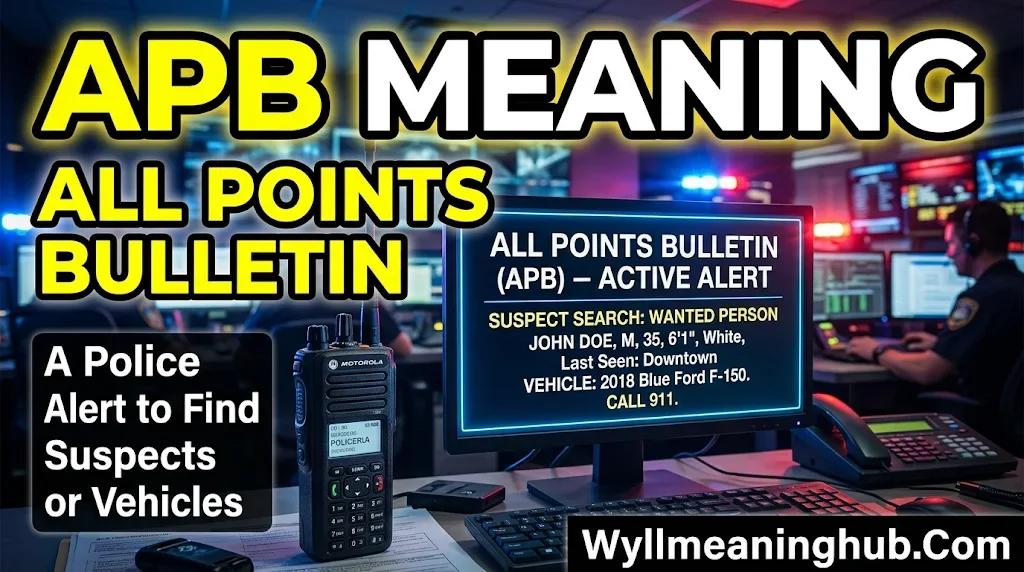
APB stands for all points bulletin. It is an urgent alert that tells police to watch for a certain suspect or vehicle. You hear it in crime shows, news reports, and everyday chats.
This guide explains the APB meaning in plain words. You will learn how an APB works, how it differs from a BOLO, and what it means in slang and on a bank statement. You will also see where else the term has shown up, from old computer networks to medical research.
Table of Contents
What Does APB Mean? All Points Bulletin Definition
The all points bulletin definition is simple. An APB is a broadcast alert sent to officers across a wide area. It says a person or a vehicle is being actively sought in connection with a crime (Merriam-Webster).
In short, APB stands for all points bulletin. Say it as “ay-pee-bee.”
Dictionaries describe it as a broadcast alert that goes from one police station to all others in an area or state. Some alerts include instructions to arrest a particular suspect (Dictionary.com).
The name explains itself:
- All points means every station, patrol car, and officer in the area.
- Bulletin means a short, urgent message.
Put together, the phrase means “a message for everyone, right now.”
Is it APB or all-points bulletin? Both are correct. Writers use “all points bulletin” and “all-points bulletin” for the same thing. “APB” is the short form.
When did the term start? The sources do not agree on one date. One dictionary entry dates the phrase to 1936. The entry for the short form “APB” lists 1953. A history source places the earliest known US police use at 1947.
The simple takeaway is that the term is about 70 to 90 years old. It grew out of early police radio and teletype networks.
Is an APB always about a crime? In police work, yes. It usually involves a serious crime or a dangerous person. In everyday talk, people use it more loosely. More on that below.
While an APB helps police locate a missing person, suspect, or vehicle through an urgent alert, the word “growler” has a completely different meaning depending on the context. Understanding the meaning of growler, its origins, and how people use it can help you recognize this interesting term in everyday conversations.
How an All Points Bulletin Works in Policing
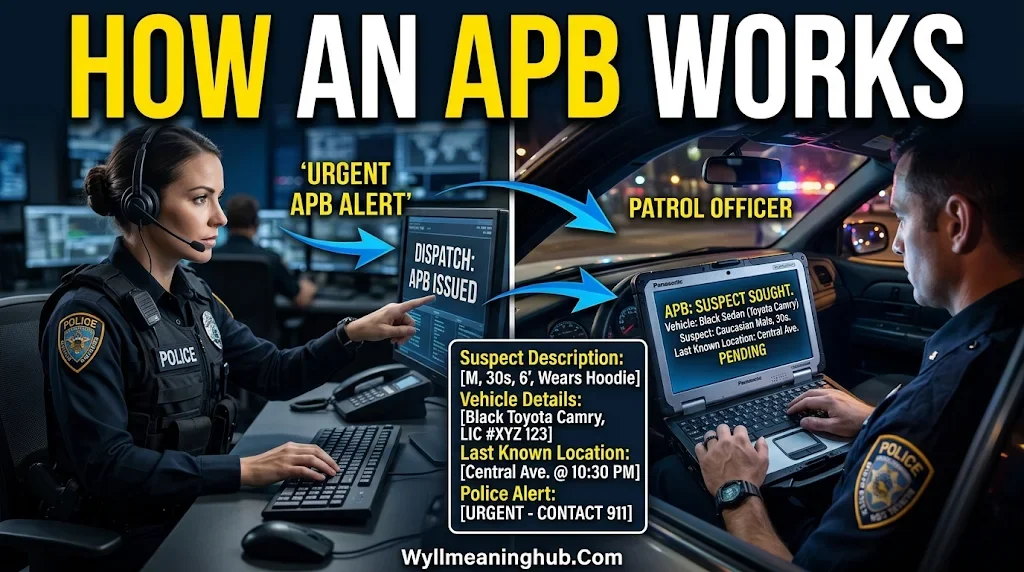
An APB moves fast. A dispatcher or officer sends it as soon as a serious case needs more eyes on the street.
What does an APB include? Most bulletins carry the same core details:
- Suspect description: height, build, hair, and clothing
- Vehicle details: make, model, color, and license plate
- Last known location, time, and direction of travel
- Danger level, such as “armed and dangerous”
- Instructions, such as “stop and detain” or “observe and report”
The wording is short on purpose. Officers are often driving when they hear it. They need the key facts in seconds.
How do officers receive it? The first APBs went out by police radio. Later, teletype machines printed the same message at every connected station. Think of a clunky typewriter linked by phone lines.
Today, officers also get alerts on a mobile computer terminal inside the patrol car. This helps when radio traffic is busy. The officer enters the same details, and other officers see the same message (source).
How fast can an APB travel? Faster than a single radio call. In 1970, a North Carolina police department reported that a teletype bulletin could reach thirteen states. Before that, a stolen-car alert spread only as far as local radio could carry it.
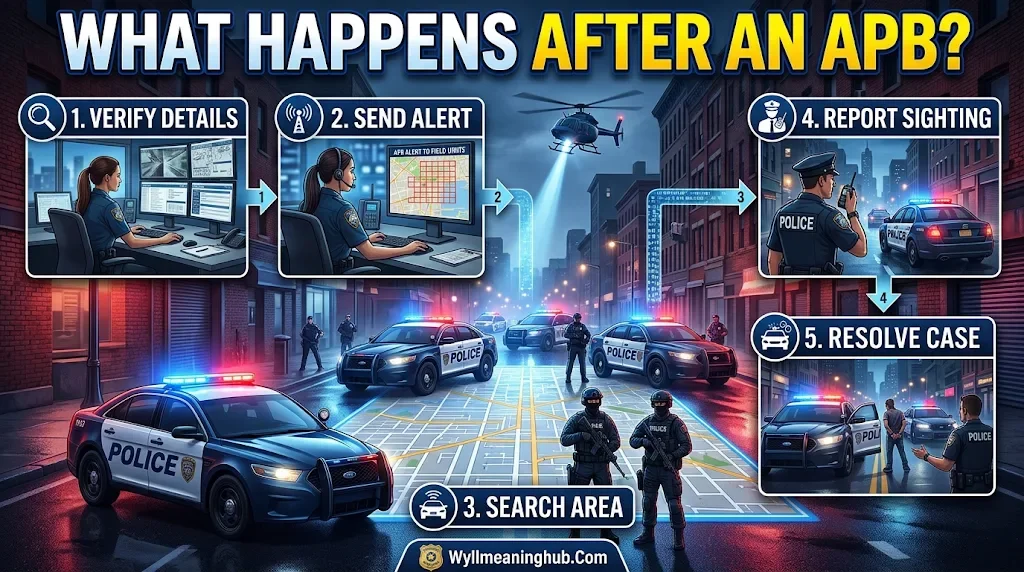
What happens after an APB goes out? The steps vary by department, but the flow is usually like this:
- An officer or dispatcher confirms the facts.
- The bulletin goes out to patrol units and nearby agencies.
- Officers watch for the person or vehicle during their shifts.
- A sighting is reported to dispatch.
- Officers respond, and the bulletin is cancelled once the case is resolved.
Do officers need a legal reason to act on an APB? Yes. In the US, police need a legal basis to stop or arrest someone. An alert alone does not replace that rule. The exact standard depends on the case and the state.
Real cases show the range. In 1973, the Portland FBI office issued a bulletin for a motorhome and a station wagon. They carried federal fugitives after a deadly firefight in Oglala, South Dakota. The vehicles were found soon after, and the fugitives were arrested (source).
APBs have also helped solve quiet cases. In 1967, the Los Angeles County Road Department found human remains in the Angeles National Forest. It sent out a bulletin with x-ray and autopsy details. Records later matched a person reported missing on 19 March 1966 (source).
Speed is not always enough. A bulletin went out on August 23, 2001, for two men the CIA had tracked for 21 months. It came too late for police to find them before the 9/11 attacks.
Is the APB still used today? Yes, but less often. Police in the US, Canada, Australia, and the UK still use it. Newer tools do much of the same work, including smartphone apps and web pages (source). License-plate readers and neighborhood cameras help officers spot vehicles without a radio call.
APB vs. BOLO, ATL, and All-Ports Warning
Several police terms sound alike. Each has its own use. This table gives you the quick difference.
| Term | Full form | Main use |
| APB | All points bulletin | Wide alert for a suspect or vehicle |
| BOLO | Be on the lookout | Same idea, common in US departments |
| ATL | Attempt to locate | Often used to find a person, not a criminal |
| APW | All-ports warning | UK alert sent to airports, ports, and rail stations |
Is APB the same as BOLO? They are close. Both ask officers to watch for someone or something. Many departments now say BOLO (be on the lookout) in daily use. Sources note that police also use ATL for “attempt to locate” (source).
What does ATL mean? ATL asks officers to find a person, often without treating them as a suspect. It fits a missing person or a welfare check better than a criminal case.
Do other countries use different terms? Yes.
- UK: The all-ports warning (APW) sends a suspect’s description to airports, ports, and international rail stations. Its goal is to stop an offender from leaving the country.
- Australia: Police in New South Wales and Victoria use KALOF or KLO4, which means “keep a look-out for.” Queensland once used BOLF. Western Australia Police use LOTBKF (source).
Is an APB the same as an Amber Alert? No. An Amber Alert is a public alert for child abductions. It reaches phones, highway signs, and news broadcasts. An APB goes to law enforcement, not the public.
A Silver Alert is different too. It is a public alert for missing older adults, and each state runs its own program.
Here is an easy way to remember the gap. An APB is a message inside the police world. An Amber Alert or Silver Alert is a message to the public.
Other APB Meanings: Slang, Banking, and Pop Culture
APB has a life outside the police station. People use it as a joke, a brand name, a title, and even a research tool.
What does APB mean in slang? In slang, “put out an APB” means “help me find someone or something.” Friends joke about it when someone goes quiet or a phone goes missing. The phrase has appeared in slang records for decades. In a text, it is usually playful sarcasm.
Here are two quick examples:
- “Do I need to put out an APB to get a reply?” (a gentle jab at a slow texter)
- “Mom put out an APB for her son’s lost stuffed animal.” (a family-wide search)
What does APB mean on a bank statement? It has no single standard meaning there. APB on a statement usually points to a merchant’s name or a payment code. Banks and sellers often advise you to ask your bank about unclear charge codes.
Here is what to do if you spot it:
- Check the date and amount against your recent purchases.
- Ask family members who share the card.
- Call the number on your card and ask for the full merchant name.
- Dispute the charge quickly if it is not yours. Credit card holders generally have about 60 days from the statement date.
Did APBs exist before the internet? In a different form, yes. Early computer systems called bulletin board systems let users post and read messages. Researchers used the term “all-points bulletin” for these shared message boards (source).
Politics used them too. In 1986, a study described politicians using electronic bulletin boards to speak with voters. Voters could write back by keyboard. Reach was small, though. In 1984, CompuServe, the leading provider, had only about 150,000 subscribers. Personal computers were in just 14% of homes (source).
Science borrowed the term as well. Researcher Frederick Kaplan sent an internet-based APB to doctors worldwide. He wanted families with a rare bone disease called fibrodysplasia ossificans progressiva (FOP). About 50 patients answered, and his team found the gene behind it, known as ACVR1 (source).
Even nature got an APB. In 2003, a land manager in Nevada saw large patches of cheatgrass vanish. A report on the mystery was called an all-points bulletin. The cause turned out to be an outbreak of army cutworms (source).
What might APBs look like next? Writers have offered a few ideas:
- A 2010 Scientific American piece described forensic profiling. It could describe a suspect from DNA traits such as ancestry and skin tone.
- Harvard professor Jonathan Zittrain suggested a future APB could ask millions of distributed scanners to look for one identity (source).
These are ideas, not current practice. They show how the concept keeps changing.
In pop culture, APB is also the name of a Fox TV show, a video game, and a few companies. Context tells you which meaning applies. If the talk is about crime or a missing item, it is the alert. If it is on a receipt or a logo, it is probably a name.
FAQs
Here are quick answers to the most common questions about the APB meaning.
What does APB mean in slang?
In slang, an APB is a joking call to find someone or something. “I’m putting out an APB on my keys” means “help me look.” It borrows the police term and adds humor.
What is the meaning of APB in a bank statement?
There is no fixed meaning. APB on a statement usually points to a merchant’s name or a payment code. Call your bank to get the full merchant details. Report the charge if you do not recognize it.
What is APB full form?
The APB full form is all points bulletin. Some writers add a hyphen: all-points bulletin.
What does APB stand for in policing?
In policing, APB stands for all points bulletin. It is a broadcast alert that tells officers in a wide area to look for a suspect or vehicle. Many departments now say BOLO instead.
What is APB short for?
APB is short for all points bulletin. In rare cases, it can also stand for a video game, a TV show, or a brand name.
Who sends an APB?
A police dispatcher or officer usually sends it. It goes to patrol units and nearby agencies.
Can the public see an APB?
Not usually. APBs are police messages. The public gets alerts like an Amber Alert instead.
In short, an all points bulletin is a fast, wide alert that helps police find a suspect or vehicle. Its roots go back to radio and teletype, and it still lives on in modern police systems. The term has also grown into everyday slang. Check the context, and you will know which APB meaning applies.

Aric ARHAM is a passionate writer and content creator dedicated to helping readers find the right words for meaningful moments in life. With a warm and thoughtful writing style, Aric creates heartfelt messages, wishes, greetings, and inspirational content that people can easily share with their loved ones.