
The voyeurism meaning is simple. It is the habit of getting sexual excitement from watching other people undress, be naked, or have sex, usually without their knowledge.
The word also has a softer, everyday use. This guide gives the full voyeurism definition, explains how it differs from a mental health disorder, and shows where U.S. law draws the line.
Table of Contents
What Is Voyeurism? Meaning and Definition
Here is the quick answer first, then the story behind the word.
What is voyeurism? Voyeurism is the practice of getting sexual gratification from watching someone’s private moments. These include undressing, nudity, or sexual activity. In the clinical and legal sense, the person being watched does not know and has not agreed.
Where does the word come from? It comes from the French word voyeur, which means “watcher.” That grew out of the verb voir, “to see.” The earliest recorded use of “voyeurism” in English dates to 1913.
The idea is much older than the word. The term peeping Tom comes from the legend of Lady Godiva. In the 1880s, Paris brothels were known for paying customers who watched through peepholes. Doctors began writing about the behavior in the early 1890s.
Understanding voyeurism also involves recognizing how people communicate about private activities, personal situations, and everyday events. Similarly, knowing the meaning of ETA (Estimated Time of Arrival) can help you understand common abbreviations used in texts, online conversations, and everyday communication.
Other words for it include:
- Scopophilia: a Greek-rooted term for the “love of looking”
- Scopophiliac: a person with that interest
- Peeping Tom: the casual, older term
- Voyeuristic behavior: the general phrase for acts and urges
Two meanings are in use today.
- The clinical and legal meaning: watching or recording private acts, often in secret, for sexual reasons.
- The everyday meaning: enjoying a glimpse into other people’s private or scandalous lives. Reality TV, tell-all books, and gossip all fit here.
Researchers have noted this shift. A well-known Harvard Review of Psychiatry paper described how the word moved from a narrow medical label to a loose cultural one.
Consent is the key idea. Two adults who both agree can explore watching and being watched. That is very different from a stranger secretly filming someone in a bathroom. The first can be a healthy fantasy. The second is a violation of privacy and often a crime.
How does it link to exhibitionism? Exhibitionism is arousal from being watched. The two often go together. In a national Swedish survey, 63% of people who reported voyeuristic acts also reported exhibitionist ones.
Types and Examples of Voyeurism
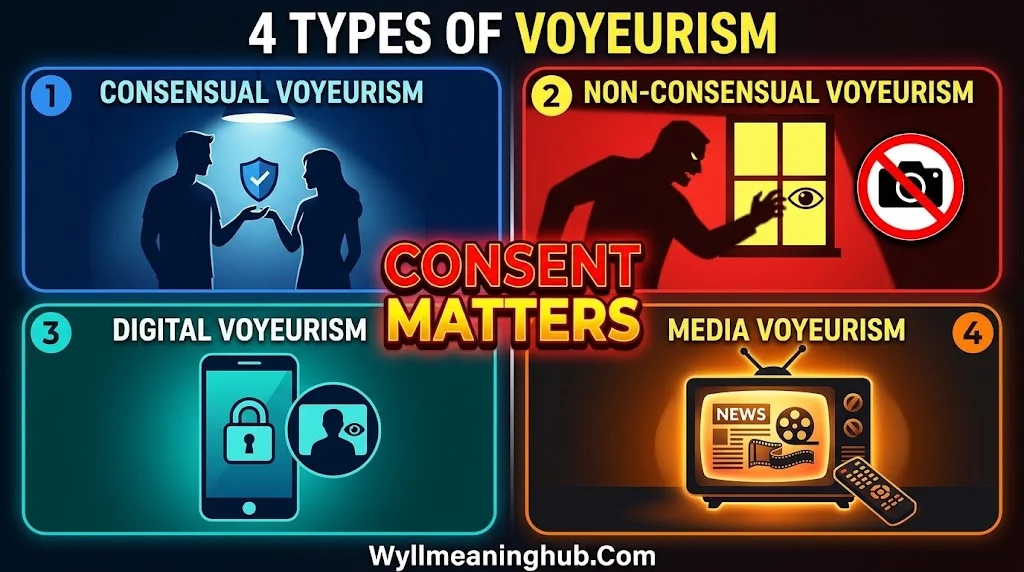
Voyeuristic behavior sits on a wide scale. Some forms harm no one. Others do serious damage.
Consensual voyeurism
Everyone involved knows and says yes. Examples include:
- Role-play between partners
- A private striptease
- A shared fantasy
- Legal adult entertainment made with the full consent of those on screen
A word of caution applies here. Some “amateur” videos online are filmed or posted without the knowledge of the people in them. Watching those can feed real harm.
Non-consensual voyeurism
This is the harmful kind. It means watching or recording a person in a private space without their knowledge. Common places include:
- Bedrooms and bathrooms
- Changing rooms and locker rooms
- Public restrooms
- Short-term rentals with hidden cameras
Courts often ask whether the person had a reasonable expectation of privacy. A shower stall clearly counts. A busy sidewalk usually does not.
Digital voyeurism
Technology has opened new doors for this crime. Today it can include:
- Hidden cameras and spy cams in rentals or workplaces
- Upskirting and “down-blousing,” where a phone captures images under or down someone’s clothes
- Smart glasses and other wearables used to record without consent. A recent UK case ended in a conviction for recording sex this way.
- Sharing private images without permission, sometimes called image-based abuse
South Korea offers a striking example. Hidden cameras there, known as molka, became such a problem that the government set up teams to sweep public restrooms and changing rooms.
Media voyeurism
This is the loose, cultural use of the word. People use it when they talk about reality TV, true-crime shows, or following strangers’ lives online. It is not a crime. It is also not a disorder. It simply borrows the word.
Film has played with the theme for decades. Rear Window (1954) and Peeping Tom (1960) are classic examples. Both ask the viewer to think about what it means to watch.
Signs that voyeuristic behavior is a problem
Watch for these red flags:
- Secrecy and deception
- Urges that feel out of control
- Watching or recording people who have not agreed
- Needing it to feel sexual satisfaction
- Guilt, shame, or distress about the behavior
- Trouble in relationships because of it
If one or more of these fit, talking to a licensed therapist is a smart next step.
Voyeurism vs. Voyeuristic Disorder
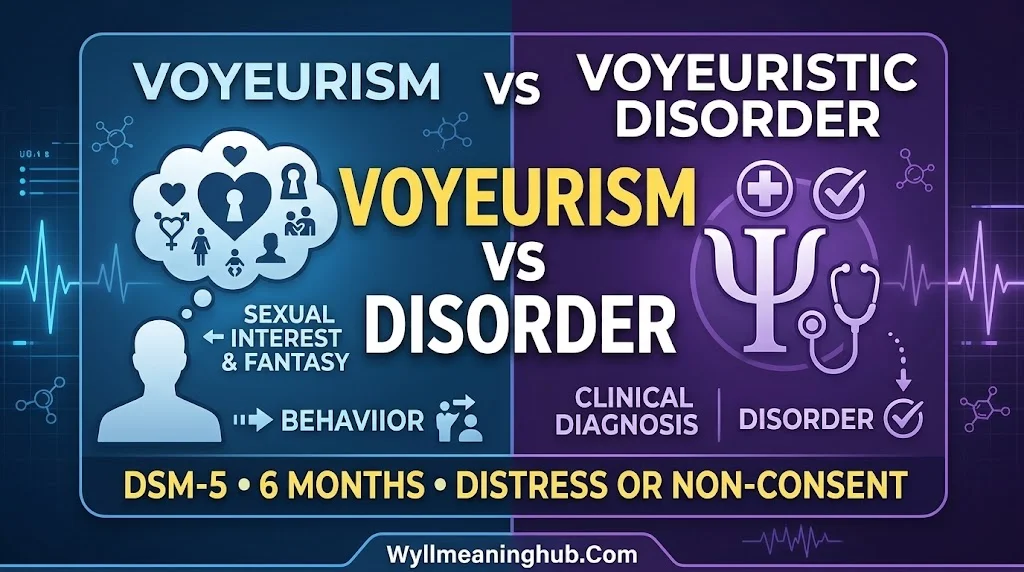
Having a voyeuristic interest does not mean a person has a mental disorder. Doctors treat these as two different things.
The DSM-5, the main diagnostic guide used in the U.S., made this split official. It separates the behavior or interest from the paraphilic disorder. A paraphilia is an intense sexual interest outside typical patterns. The American Psychiatric Association explains the difference.
What is voyeuristic disorder? It is a diagnosis. A clinician looks for these signs:
- The person is at least 18 years old.
- For six months or more, they have had strong, repeated arousal from watching an unsuspecting person who is naked, undressing, or having sex.
- They have acted on the urges with someone who did not consent, or the urges cause real distress or hurt their daily life.
Notice what is missing. A private fantasy that bothers no one, and causes no distress, does not meet the bar. Seeing nudity by accident and feeling a spark of excitement is not a disorder either.
How common is it?
More common than most people expect.
- In the Swedish national survey, 7.7% of people said they had engaged in voyeurism. That worked out to about 16% of men and 4% of women.
- Researchers from that work estimate that voyeurism happens far more often than police reports show. The gap may be as large as 150 times.
- A 2021 study asked people how they felt about the idea. About 36% of men and 64% of women felt strongly repulsed by it. Men were more likely to report mild or moderate arousal. When risk was added, willingness dropped for both sexes.
What causes it?
No one knows for sure. Several ideas exist, and none is proven.
- Psychoanalytic theory (older and widely questioned) linked it to childhood conflicts.
- Lovemap theory suggests that looking, which is normally one small part of arousal, becomes the main source of satisfaction.
- Compulsion and impulse control may play a part. Some studies link voyeurism with obsessive-compulsive patterns.
- Other conditions, such as substance use or other mental health concerns, sometimes appear alongside it.
Treat these as clues, not as answers. Plenty of people with these traits never act on voyeuristic urges.
Does the behavior ever turn dangerous?
Sometimes. Non-consensual voyeurism is a form of sexual abuse, and obsessive watching can slide into stalking. FBI researchers have noted that some people who commit “nuisance” sex offenses also show traits seen in more serious offenders, such as careful planning. That does not mean every voyeur is dangerous. It does mean the behavior should be taken seriously.
How is it treated?
Options usually include:
- Talk therapy, including cognitive behavioral therapy (CBT)
- Treatment for compulsive behavior, since methods used for OCD have helped some people
- Medication, such as an SSRI, in some cases
- Support for any co-occurring conditions, such as anxiety or depression
Older methods, such as shock-based aversion therapy, had limited success and are not seen as good practice today.
Where to start: a licensed psychologist, psychiatrist, or counselor who treats sexual behavior concerns. Many therapists offer a private first visit.
Is Voyeurism Illegal in the U.S.? Laws and Penalties
In most cases, yes. Two things decide the matter: consent and whether the person had a reasonable expectation of privacy.
Is voyeurism a crime? Yes, when someone watches or records another person in a private setting without consent. Under common law, voyeurism was not a crime on its own. It became one only when lawmakers passed specific statutes. That is why laws differ so much from place to place.
Federal law
The Video Voyeurism Prevention Act of 2004 made it a federal crime to knowingly record or share an image of someone’s “private area” where they expect privacy. The law is now 18 U.S.C. § 1801. It covers areas under federal control, such as federal buildings and military bases.
The statute defines a private area as naked or underwear-covered genitals, pubic area, buttocks, or a woman’s breast.
State law
States do most of the work, and wording varies. Most states have a voyeurism, “peeping,” or unlawful surveillance law. Many also cover:
- Secret recording in bathrooms, bedrooms, and changing rooms
- Upskirting and similar acts in public places
- Sharing or selling the images
- Using cameras, phones, or other devices
Florida’s law, for example, bans secretly watching someone with lewd or indecent intent in a place where they expect privacy.
What are the penalties?
They depend on the state and the facts. Possible outcomes include:
- A misdemeanor or a felony charge
- Fines
- Jail or prison time
- Probation
- Sex offender registration in some cases
Penalties tend to rise when the victim is a child, when the offender repeats the act, or when the images are shared.
How other countries handle it
Seeing other systems helps show how widely the offense is recognized.
- United Kingdom: Non-consensual voyeurism became a crime on May 1, 2004. Section 67 of the Sexual Offences Act 2003 covers watching, recording, operating equipment, and installing equipment. Victims get lifelong anonymity. A 2020 appeal case, R v Richards, made one point very clear. Agreeing to sex is not the same as agreeing to be filmed.
- Canada: Parliament added the offense to section 162 of the Criminal Code in 2005. In R v Jarvis (2019), the Supreme Court said privacy comes in degrees. Students at school can still expect some privacy.
- India: A 2013 amendment to the Penal Code made voyeurism a crime. A first offense carries one to three years in prison.
- Singapore: The maximum is one year in jail plus a fine for the basic offense.
What should a victim do?
If you think someone has watched or recorded you, take these steps:
- Stay safe. Do not confront the person.
- Save evidence. Keep messages, links, photos, and screenshots. Note dates and places.
- Report it. Call local police. For a hidden camera in a rental, tell the platform as well.
- Ask platforms to remove images. Most major sites have a reporting tool for private images.
- Get support. A lawyer, a victim advocate, or a counselor can help.
This section gives general information. It is not legal advice. Laws change, so check your state’s current statute or talk to a lawyer.
FAQs
Is voyeurism a crime?
Yes, when it means watching or recording someone in a private setting without consent. Laws differ by state and country. Consensual acts between adults are not crimes.
What is meant by voyeur?
A voyeur is a person who gets sexual pleasure from watching others undress or take part in sexual acts. In casual speech, it can also mean anyone who enjoys watching other people’s private lives.
What is the legal definition of a voyeur?
Most laws do not define the person. They define the voyeurism offense instead. It is usually watching or recording someone in a private place without consent, often for sexual gratification. Some laws also cover sharing the images.
What is another word for a voyeur?
Common words include peeping Tom, watcher, and observer. The formal term for the interest is scopophilia, and a person with it is a scopophiliac.
What does “female voyeur” mean?
It means a woman who has voyeuristic interest or behavior. The meaning is the same as for any voyeur. The French feminine form is voyeuse. Research on women is limited, so less is known.
Is voyeurism a mental disorder?
Not by itself. It becomes voyeuristic disorder only when a person acts on urges with a non-consenting person, or feels real distress, as set out in the DSM-5.
What is the difference between voyeurism and exhibitionism?
Voyeurism is arousal from watching others. Exhibitionism is arousal from being watched. The two often appear together.
Is watching reality TV voyeurism?
In the everyday sense, some people use the word that way. It is not voyeurism in the clinical or legal sense, because the people on screen know they are being watched.
Voyeurism comes down to consent. A fantasy shared by willing adults is one thing. Secret watching or recording is another, and it can be a crime. If urges feel hard to control, a licensed mental health professional can help. If someone has recorded you without consent, report it to the police and save your evidence.

Aric ARHAM is a passionate writer and content creator dedicated to helping readers find the right words for meaningful moments in life. With a warm and thoughtful writing style, Aric creates heartfelt messages, wishes, greetings, and inspirational content that people can easily share with their loved ones.