

You meet someone new, and they smile and say “mucho gusto.” What does it mean, and what should you say back?
Mucho gusto means “nice to meet you” in Spanish. This guide covers the mucho gusto meaning in English, how to say it, the best replies, and the mistakes to avoid. You will likely hear it in the US, where about 44.9 million people speak Spanish at home, according to USAFacts’ summary of Census data.
Table of Contents
What Does Mucho Gusto Meaning in English?
Mucho gusto is a short Spanish greeting you say when you meet someone for the first time. It works like “pleased to meet you.”
Quick answer: Mucho gusto = nice to meet you, pleased to meet you, or it’s a pleasure to meet you.
Mucho gusto meaning, word by word:
- Mucho means “a lot” or “very.”
- Gusto means “pleasure,” “liking,” or even “taste.”
- Together, the phrase means “much pleasure.”
The literal English version sounds stiff. In Spanish, it feels natural and warm. Think of it as a friendly handshake in word form.
How do you pronounce mucho gusto? Say moo-choh GOOS-toh. The “ch” sounds like the “ch” in “chair.” The “u” sounds like “oo” in “moon.” Stress the second word, gusto.
What type of word is it? It is an interjection, which means a short set phrase. You do not break it apart when you speak. You say it as one unit.
Does mucho gusto change for men and women? No. The ending stays the same for everyone. That makes it easier than encantado (said by a man) and encantada (said by a woman). If you worry about getting the gender right, mucho gusto is the safe pick.
The Costa Rica twist: In Costa Rica, people also use mucho gusto to mean “you’re welcome” or “my pleasure.” If someone says “muchas gracias,” a Costa Rican may answer “mucho gusto.” Most other Spanish-speaking places do not use it this way. In those places, de nada is the standard “you’re welcome.”
Where does the phrase fit in the language? It belongs to a big, growing language. The Instituto Cervantes yearbook for 2025 counts more than 635 million potential Spanish speakers worldwide. Of those, about 520 million speak it as a native language. Only Mandarin Chinese and Hindi have more native speakers. So when you learn this one phrase, you can use it with a huge number of people.
Related Post: HBU Meaning: What It Stands For, How to Use It, and How to Reply
How to Use Mucho Gusto meaning Like a Native Speaker
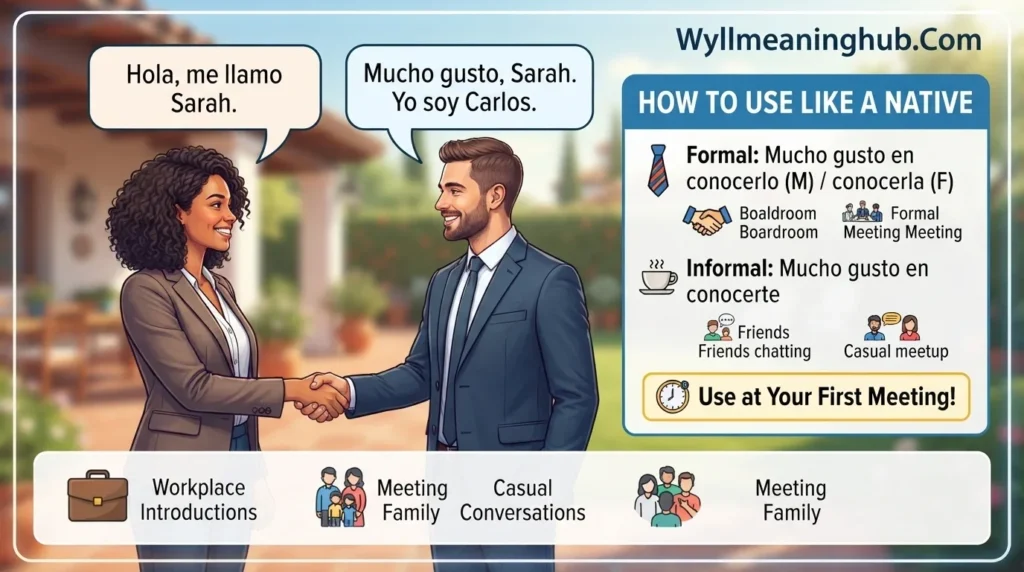
Say it right after you hear the other person’s name, or as you shake hands. Use it at the first meeting only, never when you leave.
A simple example:
- Hola, me llamo Sarah. (Hi, my name is Sarah.)
- Mucho gusto, Sarah. Yo soy Carlos. (Nice to meet you, Sarah. I’m Carlos.)
Is mucho gusto formal or informal? It is both. You can say it to a boss, a customer, a neighbor, or a new friend. To match the setting, change the longer form:
- Formal: Mucho gusto en conocerlo (to a man) or conocerla (to a woman).
- Informal: Mucho gusto en conocerte.
These endings follow the usted (formal “you”) and tú (informal “you”) rules. If you are unsure, pick the formal one. It is never rude.
Mucho gusto in real US situations:
- At work: A new teammate says, Hola, soy Ana. You answer, Mucho gusto, Ana. It is short and professional.
- On a customer call: Buenos días, mucho gusto. ¿En qué puedo ayudarle? (Good morning, nice to meet you. How can I help you?)
- Meeting family: Mucho gusto, señora García. Adding the last name or señor/señora shows respect.
- In a group: You can greet each person in turn. Many speakers also say mucho gusto a todos to greet everyone at once.
- In a Spanish class: Practice it in pairs. It is one of the first phrases teachers use.
Pair it with a warm start. A natural combo is “Hola, mucho gusto.” It sounds relaxed and friendly. Many speakers also add the person’s name, as in Mucho gusto, Daniel. That small touch feels personal.
What about body language? A smile and a handshake are standard. In many Latin American countries and in Spain, people may also greet with a light cheek kiss, especially in casual or family settings. In business, a handshake is safer. Watch what the other person does, then follow their lead.
Can you use it in writing? Yes. In a first email or message, a line like Mucho gusto, soy Laura works well. It feels warm and clear. Use the conocerlo/conocerla form for formal writing.
Tone tips:
- Look at the person while you say it.
- Keep your voice calm and friendly.
- Do not rush the words.
- Say the name clearly, since names matter in an introduction.
How to Respond to Mucho Gusto
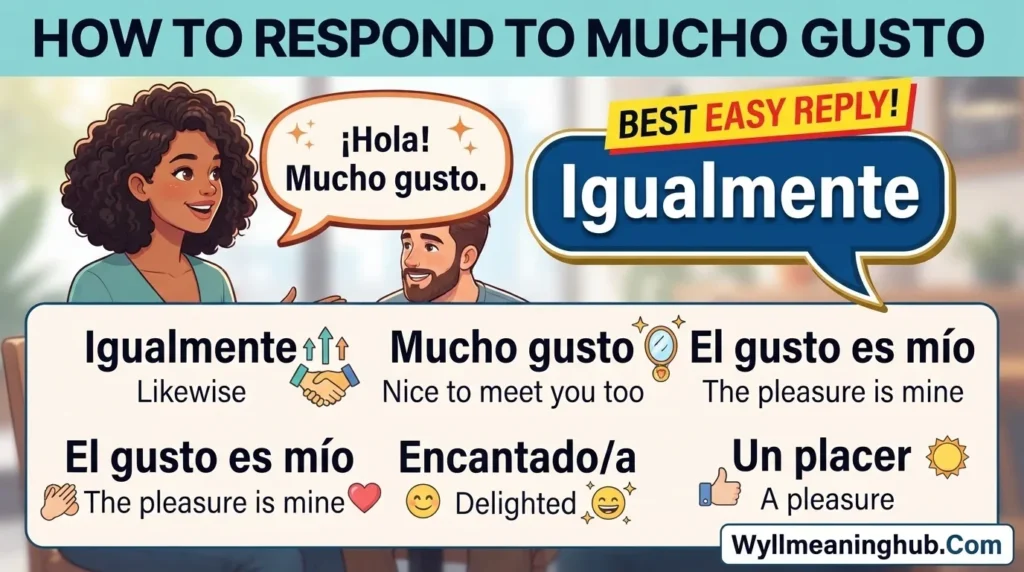
The easiest reply is to say it back. You can also pick a more polished option.
| Situation | What to say | Meaning |
| Quick and simple | Igualmente | Likewise |
| Casual | Mucho gusto | Nice to meet you, too |
| Warm | El gusto es mío | The pleasure is mine |
| Short and polite | Encantado / Encantada | Delighted |
| Formal | Un placer | A pleasure |
What do you say after “mucho gusto”? Add your name if you have not shared it yet. Then ask a simple follow-up, such as ¿Cómo estás? (How are you?) or ¿De dónde eres? (Where are you from?).
A full short chat looks like this:
- Mucho gusto. Me llamo Javier.
- Igualmente, Javier. Yo soy Emily.
- ¿Cómo estás, Emily?
- Muy bien, gracias. ¿Y tú?
Notice the order. First comes the introduction. Then comes the small talk.
How do you reply formally? Use el gusto es mío or un placer. Add señor or señora if it fits. For example: El gusto es mío, señora López.
Why does “igualmente” work so well? It fits every situation. It is short, polite, and easy to say. If you only learn one reply, learn this one.
Mucho Gusto Alternatives and Common Mistakes
Spanish has several ways to say “nice to meet you.” Pick one based on how warm or formal you want to sound.
Alternatives to mucho gusto:
- Un placer (a pleasure)
- Encantado / Encantada (delighted)
- Es un gusto conocerte (it’s a pleasure to meet you)
- Encantado de conocerte (delighted to meet you)
- Muchísimo gusto (a very big pleasure, for extra warmth)
The extra “-ísimo” ending boosts the feeling. It can sound a bit strong in English, but it is normal in Spanish when you want to show real warmth.
Does it change by country? The core meaning stays the same across the Spanish-speaking world. Small habits differ, though, such as the Costa Rican “you’re welcome” use. In the US, USAFacts reports that California (28.8%) and Texas (28.2%) have the highest shares of Spanish speakers at home, so you may hear regional styles of Spanish there.
Common mistakes learners make:
- Saying it as goodbye. It only works for a first meeting. For goodbye, use adiós, hasta luego, or nos vemos.
- Mixing it up with “me gusta.” Me gusta means “I like it.” It is a different phrase.
- Using the wrong gender. Say encantado for a man and encantada for a woman. Use mucho gusto to avoid the choice.
- Giving it a romantic meaning. It is a plain, friendly greeting.
- Answering with “estoy bien.” That phrase answers “how are you,” not an introduction.
- Speaking too quietly or too fast. A clear, calm voice helps the other person catch your words.
- Skipping the name. Names make introductions feel real. Say theirs back once.
Quick cheat sheet:
| Phrase | Meaning | Best for |
| Mucho gusto | Nice to meet you | Any first meeting |
| Encantado/a | Delighted | Warm, polite settings |
| Un placer | A pleasure | Formal moments |
| Igualmente | Likewise | A fast reply |
| El gusto es mío | The pleasure is mine | A warm reply |
FAQs
Is mucho gusto mpolite?
Yes. It is a polite, standard greeting. It works in formal and casual settings, from job interviews to family dinners.
Is mucho gusto “my pleasure”?
Not usually. It normally means “nice to meet you.” In Costa Rica, it can also mean “my pleasure” or “you’re welcome.” Elsewhere, the usual way to say “the pleasure is mine” is el gusto es mío.
Does mucho gusto mean “I love you”?
No. It has no romantic meaning. It is a friendly phrase for meeting someone new. The words “I love you” in Spanish are te quiero or te amo.
What is mucho gusto used for?
You use it when you meet someone for the first time. This can happen in person, on a phone call, in an email, or during a formal introduction. In Costa Rica, people also use it as a reply to “thank you.”
Can I say “estoy bien”?
Not as a reply to an introduction. Estoy bien means “I’m fine” and answers “¿Cómo estás?” After someone says mucho gusto, answer with igualmente, encantado/a, or mucho gusto. You can then ask how they are.
The mucho gusto meaning is simple: it is a warm “nice to meet you.” Say it at the first hello, match your tone with usted or tú, and answer with igualmente. Use it well, and you will sound polite, confident, and natural.

Aric ARHAM is a passionate writer and content creator dedicated to helping readers find the right words for meaningful moments in life. With a warm and thoughtful writing style, Aric creates heartfelt messages, wishes, greetings, and inspirational content that people can easily share with their loved ones.