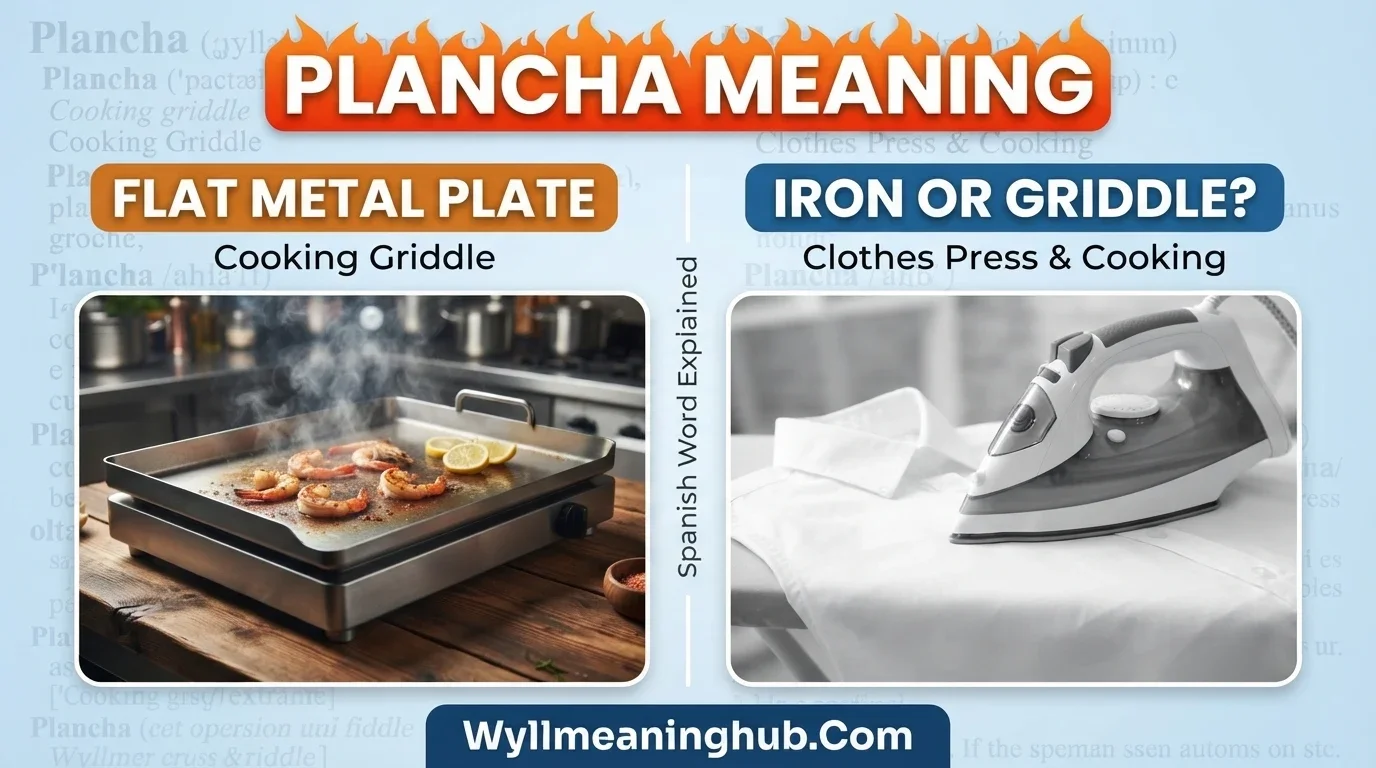
Plancha meaning starts with one simple idea: a flat plate. In Spanish, plancha can be a griddle, an iron, or a slab, depending on where you meet it.
You may have seen “a la plancha” on a US menu and wondered what it means. This guide covers what plancha means, how plancha food is cooked, and what the slang means.
Table of Contents
What Does Plancha Meaning ? Definition and Origin
Plancha is a Spanish word for a flat, heated or pressed surface. Here is where it comes from, how to say it, and why one word does so many jobs.
What does plancha mean? In Spanish, it means a flat metal plate. In a kitchen, it is a hot flat-top that sears food. At home, it is the tool you use to press clothes.
The Collins English Dictionary lists “a la plancha” as a 20th-century borrowing from Spanish. It means “on the plate.” In English, the phrase works as an adjective: “prawns a la plancha” means prawns grilled on a metal plate.
Spain’s Royal Spanish Academy (RAE) gives the full picture. Its entry for plancha lists several senses:
- A flat sheet of metal.
- The act of ironing clothes.
- A pile of ironed clothes.
- An iron plate used to roast or toast food.
The same entry defines a la plancha as food roasted or toasted on a hot plate. Its example is carne a la plancha, or “meat on the plate.”
The word has relatives in English. Wiktionary calls it a doublet of planch, planche, plank, phalanx, and phalange. A doublet is a pair of words that share one ancient root but took different paths. The link is easy to see: plank and plancha both describe a flat, solid piece.
The word also traveled far. It became plantsa in Tagalog and Cebuano, where it means “iron.” It became pilinsa in Maguindanao. These are the same clothes-pressing tool, named after a Spanish word.
Say it like PLAHN-chah. The “ch” sounds like the “ch” in “chair.” English speakers often say “PLAN-cha” with a flat “a.” Either way, people will understand you in a US restaurant.
Plancha vs planchar: Plancha is the noun. Planchar is the verb. Plancha can also be a verb form: “Ella plancha la camisa” means “She irons the shirt.” So the same spelling can be a thing or an action.
Related Post: PMO Meaning: Everything You Need to Know About Project Management Offices
Plancha Meaning in English and Spanish: Every Translation
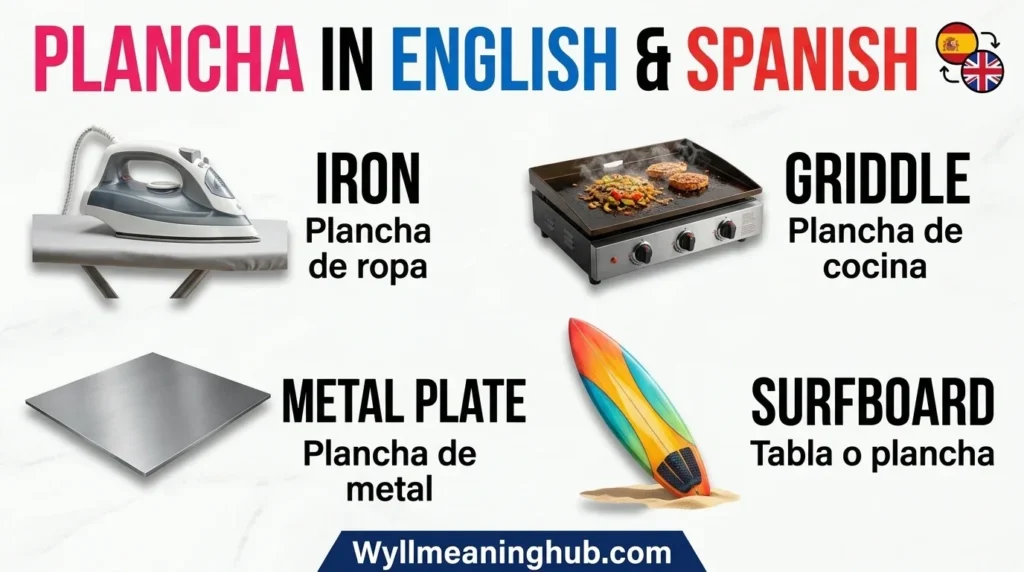
One Spanish word can have many English matches. Here is how plancha translation splits across uses.
Translation-usage data shows how lopsided it is. Iron covers about 70% of uses. Plate covers about 25%. Griddle covers about 3%, and slab about 2%. So “griddle” is rare in daily Spanish. It is still the sense you will meet most often on a menu.
Here is a quick guide:
| Spanish term | English meaning | Where you see it |
|---|---|---|
| plancha | iron, plate, griddle | Home, kitchen |
| plancha eléctrica | electric iron | Household |
| plancha de vapor | steam iron | Household |
| plancha de ropa | clothes iron | Household |
| planchar | to iron, to press | Chores |
| a la plancha | grilled on a hot plate | Restaurants |
| plancha de surf | surfboard | Beach, sport |
| plancha de blindaje | armor plate | Military, industry |
| hacer la plancha | to float, or to do the ironing | Swimming, home |
Spanish also offers other words for “plate.” Examples are placa, chapa, lámina, and bandeja. For “iron,” you will hear hierro, acero, and fierro. These words overlap with plancha but are not always swappable. A plato, for example, is a dinner plate, not a cooking surface.
What is a plancha in Spanish? It is a feminine noun. You say la plancha for one and las planchas for many.
What is the English of plancha? It depends on context. A clothes store or a home means “iron.” A kitchen means “griddle.” A building site means “slab” or “metal sheet.”
Other languages borrowed the word too. In French, plancha means a smooth cooking plate, often made of metal or stone. It is used to sear food at very high heat. French cooks sometimes use pierrade as a close synonym. In Italian, the usual match is piastra.
One warning for learners: do not mix up plancha with planche. In French, planche means “board,” as in a cutting board or a surfboard. In Spanish, planchá with an accent is a different word form. A missing accent or letter can change the meaning, so check the spelling.
What Is Plancha Food? How a la Plancha Cooking Works

Plancha food is food seared on a very hot, flat metal plate. The goal is a golden crust outside and a juicy center inside.
A plancha can reach about 350°C (662°F). That is far hotter than a normal home skillet. The heat often peaks in the middle of the plate. Cooks slide food from the hottest spot to the cooler edges to finish gently.
That browning comes from the Maillard reaction. It starts above roughly 140°C (285°F). It builds deep, savory flavor on the surface of seafood, steak, and vegetables. A plancha makes this easy because it holds high, steady heat.
The plate matters a lot. Many planchas have a non-reactive chrome surface. This keeps flavors clean and makes cleanup easier. Thin plates under 6 mm create hot spots and cool fast when cold food lands on them. Thick plates hold heat and recover faster.
Old thin plates also warped. The middle popped up into a small hump. That hump drained excess grease away from the food. It kept the food moist, unlike a barbecue grate that can dry it out. Many modern planchas now use a slight slope to copy the effect.
Is a plancha the same as a griddle? Not quite. A basic griddle is thin and cheap. It works well for eggs, bacon, and pancakes. A French plancha is thicker, more refined, and more even. Makers such as Bonnet and Athanor are known for this style. A French plancha can give results close to pan-frying, with more consistency.
That difference matters in pro kitchens. Master plancha chef Tim Tolley once used a Bonnet plancha for scallops and prawns at Plateau Restaurant in Canary Wharf. Scallops, prawns, and foie gras need steady, controlled heat. A thin griddle often can’t deliver it.
Pro kitchens also like how a plancha cuts down on pans. Fewer pans means less washing up and less cleaning chemical use. Many modern units also run on induction, which can save energy.
Here is how the main tools compare:
- Plancha: A thick flat plate, very hot, with a heat gradient. Best for seafood and steak.
- Flat-top or griddle: A flat plate, often thinner. Best for breakfast food.
- Teppanyaki: A Japanese “iron plate” grill. It is a close cousin of the plancha.
- Cast iron skillet: A pan with sides. It holds heat well but has less space.
- Grill pan or barbecue grate: Ridged or open. Juices drip away and flare-ups can happen.
What foods are cooked a la plancha? Seafood is the classic choice. Gambas a la plancha (pan-seared prawns) sit next to patatas bravas as an icon of Spanish tapas. Other favorites include:
- Octopus and squid
- Mackerel and salmon
- Razor clams and berberechos (small Spanish cockles)
- Scallops and langostinos
- Steak, pork chops, and duck breast
- Vegetables, tacos, and melted cheese
Seasoning stays simple. Use olive oil, lemon, and a little garlic. Skip heavy marinades. The point is to show off the freshness of the food.
The method is easy to remember:
- Preheat the plate until it is very hot.
- Pat the food dry so it sears instead of steams.
- Oil the food, not the plate.
- Sear the first side without moving it.
- Flip once, then slide the food to a cooler zone to finish.
For safety, the USDA lists 145°F as the safe internal temperature for fish and for whole cuts of beef and pork. Ground meat needs 160°F. Poultry needs 165°F. A probe thermometer takes out the guesswork, because a good sear can hide a raw center.
What does “a la plancha” mean on a US menu? It means the dish was seared on a flat-top. It is not deep-fried and not drowned in sauce. Expect a crisp edge, a tender middle, and a light finish of oil and lemon.
You can cook this way at home. Use a gas grill plancha insert, a steel plate over a stove burner, or an electric flat-top. Ventilate well, because high heat makes oil smoke.
Cleanup is quick. Scrape the plate while it is still warm. Wipe it down. Add a thin film of oil to a steel plate to keep rust away.
Plancha Slang Meaning and Other Uses
Beyond the kitchen, plancha picks up slang and sports meanings. Context tells you which one applies.
What does the slang term “plancha” mean? It depends on the region. Here are the main uses:
- Gaffe or blunder: In some regions, plancha means an embarrassing slip.
- Stand someone up: In Mexico, tirar una plancha means to leave someone waiting. RAE records it as a Mexican phrase meaning dar un plantón.
- Float or iron: Hacer la plancha can mean floating flat on your back in water. It can also mean doing the ironing.
- Plank exercise: Spanish gyms call the plank la plancha. You hold your body flat and straight, like a board.
- Lucha libre: In Mexican wrestling, a plancha is a flying body splash off the ropes. The wrestler goes flat, like an iron coming down.
- Surfing: A plancha de surf is a surfboard.
Notice the pattern. Every use points back to something flat. A plate, a board, a body held straight, or a wrestler landing flat. Once you see that, new meanings are easier to guess.
A quick tip for US learners: do not assume one meaning fits every setting. If a Spanish speaker says plancha in a kitchen, think “griddle.” In a laundry room, think “iron.” In a gym, think “plank.” In a conversation about plans that fell through, think “stood up” or “blunder.” Slang shifts from country to country, so when in doubt, ask.
FAQs
What is the English of plancha?
It depends on context. Most often, plancha means “iron,” as in a clothes iron. In cooking, it means “griddle” or “flat-top.” It can also mean plate, slab, or gaffe. On menus, think “seared on a hot plate.”
What is a plancha in Spanish?
In Spanish, la plancha is a feminine noun for a flat, solid surface. It can be an iron, a metal plate, or a cooking griddle. The verb planchar means to iron or press. The plural is las planchas.
What is a plancha food?
Plancha food is cooked on a very hot flat metal plate. Seafood is the classic choice: prawns, octopus, scallops, and razor clams. Steak, vegetables, and tacos also work. Cooks use olive oil, lemon, and garlic, then sear quickly.
What does the slang term “plancha” mean?
Slang meanings vary by region. It can mean an embarrassing blunder. In Mexico, tirar una plancha means to stand someone up. In wrestling, a plancha is a flying body splash. In fitness, it is the plank exercise.
What does plancha mean?
Plancha means a flat metal plate in Spanish. It can be a clothes iron, a cooking griddle, or a slab. “A la plancha” means grilled on a hot plate. The exact meaning depends on context.
Now you know what plancha means in every setting. It is a flat plate, whether it presses a shirt, sears a prawn, or names a wrestling move. Next time you see “a la plancha” on a menu, expect a hot, quick sear and simple flavors. At home, a good plate and a little patience will get you the same result.

Aric ARHAM is a passionate writer and content creator dedicated to helping readers find the right words for meaningful moments in life. With a warm and thoughtful writing style, Aric creates heartfelt messages, wishes, greetings, and inspirational content that people can easily share with their loved ones.